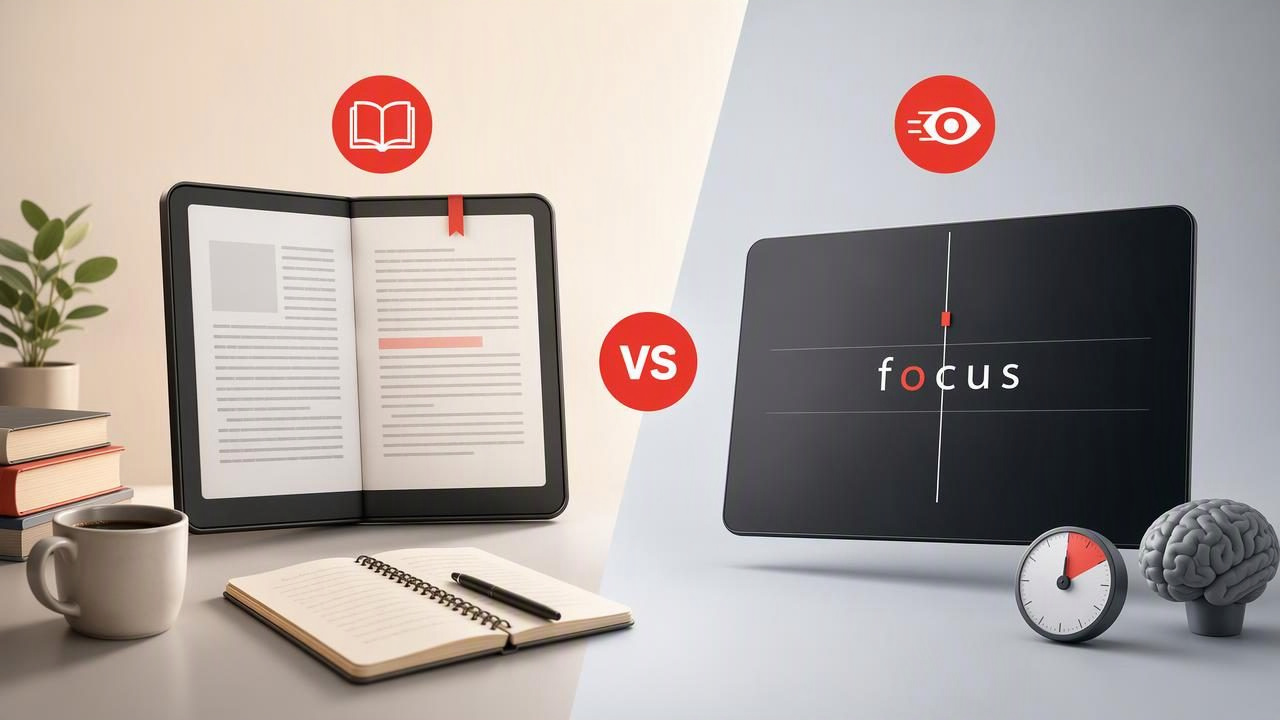
Choosing between an EPUB speed reader vs Spritz reader comes down to more than raw words per minute. Both approaches can help reduce distractions and make digital reading feel more intentional, but they present text in very different ways.
An EPUB speed reader typically lets you import an ebook and read it in a controlled environment, often with adjustable text settings or a rapid serial visual presentation (RSVP) mode. A Spritz-style reader, by contrast, presents words one at a time in a fixed focal position. That format can make it easier to maintain visual attention, but it may not suit every kind of material.
The best choice depends on what you read, why you are reading it, and how much comprehension you need to retain. A novel, an academic chapter, a legal document, and a short news article all place different demands on your attention.
What Is an EPUB Speed Reader?
An EPUB speed reader is a reading tool that opens EPUB files and helps you move through ebook content with fewer interruptions. EPUB is a flexible ebook format used for many novels, textbooks, public-domain books, and publisher-provided digital editions. Unlike a static PDF, an EPUB usually allows text to reflow to fit the screen.
That flexibility matters on an iPhone or iPad. You can generally make the text larger, reduce line length, change spacing, or switch between standard page reading and a faster presentation mode when supported by the app. The reader remains connected to the structure of the book: chapters, paragraphs, headings, and the natural rhythm of the writing.
For speed-reading practice, an EPUB reader may be useful because it gives you a complete book-length source. Instead of practicing only with short snippets, you can build a routine around material you actually want or need to finish.
Typical strengths of EPUB-based reading
- Long-form context: You can follow chapters, arguments, and story development over time.
- Flexible display: Reflowable text is often more comfortable on smaller screens.
- Useful source material: You can practice with assigned reading, nonfiction books, or personal ebook files.
- Multiple reading styles: You may be able to alternate between normal reading, skimming, and word-by-word pacing.
What Is a Spritz Reader?
A Spritz reader usually refers to a word-at-a-time RSVP reading format. Instead of scanning across lines, the reader displays each word or short word group in roughly the same place on the screen. The goal is to limit eye movement and keep your attention on a central focal area.
This type of reading can feel dramatically different from reading a page. In conventional reading, your eyes move across each line and return to the next one. In a one-word reader, the display advances for you at a selected pace. You do less visual navigation, but you also have less freedom to pause naturally on a phrase or look back at a previous sentence.
“Spritz reader” is often used as shorthand for this presentation style, although implementations can vary. Some tools emphasize a visually marked focal letter, while others simply use centered word presentation. What matters most is the reading behavior: text arrives in a rapid, sequential stream.
EPUB Speed Reader vs Spritz Reader: Key Differences
| Factor | EPUB Speed Reader | Spritz-Style Reader |
|---|---|---|
| Text layout | Book-like, reflowable pages or chapters | One word or short unit at a time |
| Navigation | Easy to scan, reread, and move between sections | Less natural to review earlier passages |
| Focus demands | Requires line tracking and page awareness | Reduces visual scanning but demands steady attention |
| Best for | Books, chapters, and structured long-form reading | Shorter passages and focused speed practice |
| Comprehension checks | Easy to pause and annotate mentally or in notes | Important to pause after a section and recall key ideas |
Neither format is automatically better. A reader who loses focus while moving across dense lines may appreciate the fixed visual position of a Spritz-style mode. Another reader may find that the absence of visible paragraphs makes it harder to understand a nuanced argument. Your reading objective should guide the choice.
When an EPUB Speed Reader Is the Better Fit
Choose an EPUB speed reader when the structure of the text supports your comprehension. This is especially true for books with chapters, recurring concepts, detailed explanations, dialogue, or references that you may need to revisit.
For example, imagine you are reading a 20-page chapter of a business book for work. The chapter explains a framework in five steps, then gives examples and caveats. Reading the chapter in EPUB form allows you to see where a new section begins, pause on the framework, and return to a definition when an example refers back to it.
You can still make the session more efficient without treating speed as the only measure of success:
- Preview the chapter title and section headings.
- Set a reading pace that feels slightly challenging but not rushed.
- Read one section at a time rather than forcing yourself through the whole chapter.
- After each section, state the main point in one sentence.
- Slow down when the author introduces definitions, evidence, or exceptions.
This workflow helps you use an EPUB file as a real learning resource rather than as a speed test.
When a Spritz-Style Reader Is the Better Fit
A Spritz-style reader may work well when your main obstacle is distraction. Because only a small amount of text is visible at once, there are fewer visual elements competing for your attention. It can be a useful format for reading a short article, reviewing familiar material, or building the habit of sustained attention.
Consider a student reviewing a 600-word article before class. They already know the topic but want a fast refresher. A word-at-a-time mode can create a clear forward rhythm: start at a comfortable pace, keep attention on the displayed word, and finish the article without bouncing between notifications, sidebars, and unrelated tabs.
Afterward, the student should stop and test recall. They might ask:
- What was the author’s central claim?
- What two examples supported it?
- Which term or idea would I need to explain in class?
If they cannot answer those questions, the pace was probably too high for that material, or the material deserves a second pass in a more navigable layout.
Why Comprehension Should Set Your Reading Speed
Fast reading only helps when you understand enough of what you read for your purpose. There is no universal words-per-minute target that works for every reader or every document. Familiar vocabulary, sentence complexity, prior knowledge, fatigue, and reading purpose all affect a sustainable pace.
A useful approach is to treat speed as a variable, not a score to chase. Increase it gradually, then check whether you can accurately summarize the material. If your recall becomes vague, reduce the speed. If you can explain the key points easily, you may be ready to increase it a little.
A productive reading pace is the fastest pace that still lets you explain what matters.
This principle is particularly important for study tools. Reading a literary passage for enjoyment, scanning a routine email, and learning a scientific concept require different levels of detail. A rapid display mode may be excellent for one task and unhelpful for another.
Limitations to Consider Before Choosing
Both formats have trade-offs. An EPUB speed reader can still encourage rushing if you increase the pace before your comprehension is stable. A word-at-a-time reader can make rereading, comparing sentences, and noticing document structure more difficult.
Spritz-style reading may be less suitable for tables, poetry, code, equations, footnotes, citations, and documents where page layout conveys meaning. In those cases, a conventional EPUB view or a document reader may be more practical. Likewise, EPUB files are not always available for every document, and formatting quality can differ between publishers.
It is also worth remembering that reading speed gains are not guaranteed. Consistent practice can help some people improve focus and efficiency, but the outcome depends on the material and the reader’s goals. Use comprehension checks, not just a timer, to judge whether a method is helping.
How to Choose the Right Mode for Your Next Reading Session
Use this quick decision guide:
- Choose EPUB reading when you need context, easy review, chapter navigation, or a natural book-reading experience.
- Choose a Spritz-style mode when you want a tightly focused session with minimal visual distraction.
- Use both when you want to preview or review straightforward sections quickly, then switch back to the EPUB layout for difficult passages.
A practical hybrid method is to read the first section in standard EPUB view, use a rapid mode for a familiar middle section, and return to standard view for the conclusion or any material you need to quote, study, or discuss. This gives you control rather than forcing every text into one reading style.
Build a More Intentional Digital Reading Habit
The EPUB speed reader vs Spritz reader decision is ultimately about matching the display to the task. If you are reading for deep understanding, preserve enough context to think through the author’s ideas. If you are reading a straightforward article and need help staying on task, a focused word-by-word presentation may be worth trying.
Track more than speed over a few sessions: note the material type, your chosen pace, whether your attention drifted, and how well you could summarize the text. Those observations will help you identify the format that supports your reading habits best.
For iPhone and iPad readers who want to practice adjustable RSVP reading with imported EPUB and other supported document formats, FocalRead’s guide to reading faster offers a practical starting point for pairing pace adjustments with comprehension checks.