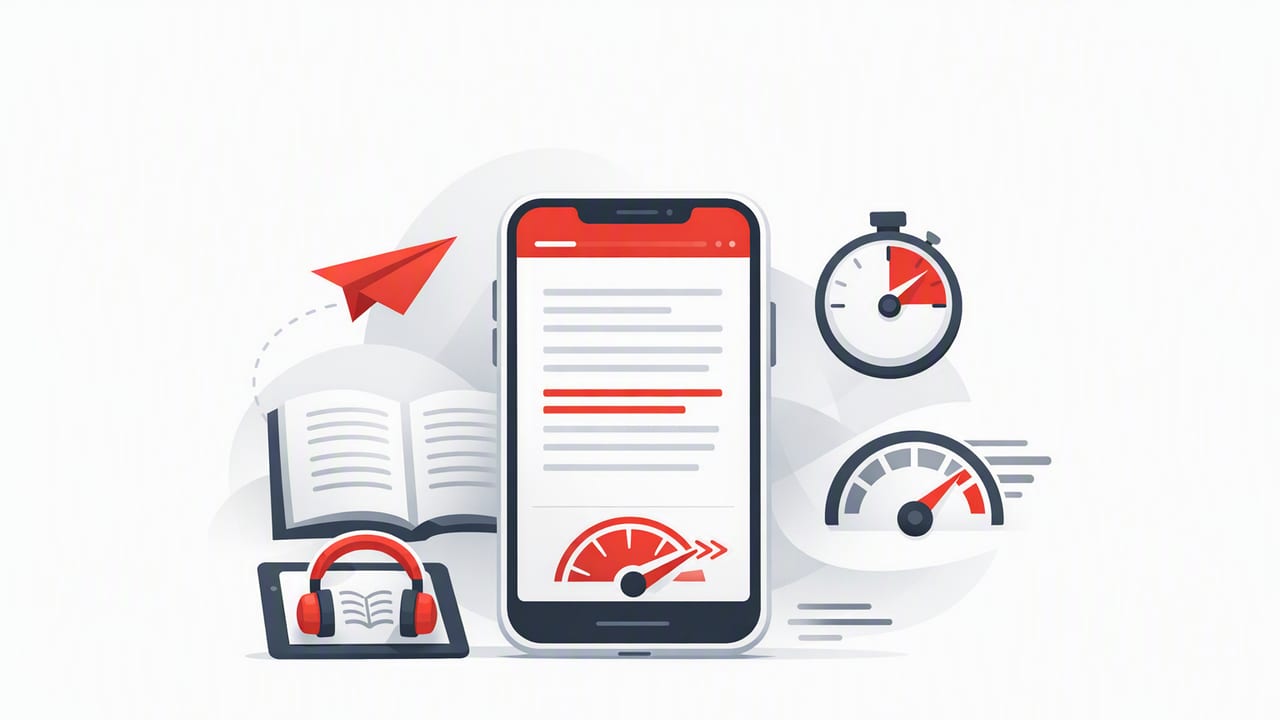
Reading faster isn’t just about moving your eyes quickly across a screen. The real goal is higher words per minute (WPM) with solid comprehension—especially when you’re reading for school, work, or learning. A fast reading app can help by structuring how text appears, reducing distractions, and giving you measurable training loops.
This guide walks through the most effective ways to use a fast reading app on iPhone and iPad, including the settings that matter, the drills that work, and the habits that keep your understanding intact.
What a fast reading app actually changes (and why it works)
Most people plateau because they read on “autopilot”: line-by-line scanning, frequent regressions (backtracking), and constant interruptions. A fast reading app improves speed and focus by shaping three constraints:
- Pacing: You read at a controlled rate instead of variable bursts and stalls.
- Visual efficiency: Tools like RSVP or guided highlighting reduce wasted eye movement.
- Feedback: WPM, time spent, and session length create a training environment rather than a vague intention.
Done well, these constraints reduce friction and make reading feel more like a deliberate skill practice than a passive activity.
Choose the right reading mode: RSVP vs guided scrolling
Fast reading apps typically use one (or both) of these approaches:
1) RSVP (Rapid Serial Visual Presentation)
Words (or short chunks) appear in a fixed position. This minimizes eye movement and encourages steady pacing.
- Best for: articles, emails, briefs, simpler narrative text
- Watch out for: dense technical writing, formulas, or highly visual content
2) Guided scrolling / highlighting
The text remains in paragraph form, but your attention is guided—by highlighting, a moving window, or line focus.
- Best for: textbooks, academic PDFs, complex arguments
- Watch out for: mindless skimming (you can “follow” without understanding)
| Mode | Speed Potential | Comprehension Potential | Ideal Use |
|---|---|---|---|
| RSVP | High | Medium–High (with practice) | Articles, business reading, general learning |
| Guided scrolling | Medium | High | Study, technical reading, long-form nonfiction |
Practical rule: If you’re losing meaning, switch to guided scrolling. If you’re bored or drifting, RSVP can tighten focus.
Set WPM correctly: the “challenge but don’t break” principle
The biggest mistake with a fast reading app is setting the speed too high too soon. If your brain is constantly falling behind, you’ll compensate by guessing—and comprehension collapses.
Try this calibration method:
- Find your comfortable WPM (where comprehension feels easy).
- Increase speed by 10–15%.
- Read for 2–3 minutes.
- Ask: “Can I summarize this in 2–3 sentences?” If yes, keep it. If no, drop back slightly.
Speed without comprehension is just scrolling. The goal is controlled pace plus accurate recall.
Use chunking and fixation control to reduce regressions
Two of the most common speed killers are (1) reading word-by-word and (2) constantly rereading. Your app can help, but your technique matters.
Chunking
Instead of processing single words, aim to process 2–4-word chunks. Many apps allow phrase-based display or adjustable grouping. If you’re reading paragraphs, practice chunking by focusing on meaning units rather than individual words.
Fixation control
Fixations are the moments your eyes “stop” to take in information. Better readers use fewer fixations per line. In RSVP, the fixation point is handled for you; in paragraph modes, you can improve by:
- Using a line guide or highlight window
- Increasing font size slightly to reduce visual fatigue
- Reducing backtracking by trusting context (especially in simpler text)
Comprehension safeguards: three quick checks that keep you honest
Reading faster is only valuable if you can use what you read. Add lightweight comprehension checks:
- One-sentence summary: After each section, write a single sentence capturing the point.
- Keyword recall: List 3–5 key terms or claims without looking.
- Question test: Ask, “What problem is this trying to solve?” or “What’s the argument?”
If you can’t do these quickly, your WPM is likely set too high or the text is too complex for the current mode.
A 15-minute daily training routine (iPhone or iPad)
Consistency beats marathon sessions. Here’s a simple, sustainable routine you can run in most fast reading apps:
Minutes 1–3: Warm-up at comfortable speed
- Read something easy (news recap, familiar topic).
- Focus on rhythm and minimizing distractions.
Minutes 4–10: Speed intervals
Alternate speeds to nudge your limits without burning comprehension:
- 1 minute at +15% WPM
- 1 minute at baseline WPM
- Repeat 3 times
Minutes 11–15: Comprehension pass
- Switch to guided scrolling or lower WPM.
- Summarize the key point in 2–3 sentences.
- Capture notes or highlights you’ll actually reuse.
This routine trains both speed capacity (intervals) and meaning retention (comprehension pass).
Settings that matter more than people think
Small tweaks can make fast reading dramatically easier—especially on mobile screens.
Font and spacing
- Font size: Slightly larger can reduce fatigue and errors.
- Line spacing: More spacing helps if you lose your place often.
- High contrast: Dark text on light background (or the reverse) should feel comfortable for long sessions.
Chunk size / words per flash (RSVP)
- Start with 1 word per flash for control.
- Move to 2–3 word chunks once you’re stable.
Pause and rewind behavior
Choose controls that keep you from spiraling into constant backtracking:
- Enable a short rewind (e.g., 1–2 seconds) rather than jumping far back.
- Use tap-to-pause so you can stop instantly when meaning slips.
Build a distraction-proof workflow on iOS
A fast reading app helps, but your environment matters. On iPhone and iPad, you can reduce interruptions in seconds:
- Focus mode: Allow only essential notifications during reading sessions.
- Auto-brightness check: Sudden dimming can cause fatigue; set a comfortable brightness.
- Single-task setup: Split View on iPad can work for notes, but close everything else.
Optional: Quick “send article to reading session” shortcut
If you often read web articles, a Shortcuts-style workflow reduces friction. Conceptually, you want: share article → extract text → open in your reader.
// Pseudocode for an iOS Shortcut-like flow
INPUT: Share Sheet URL
1) Get Article from URL
2) Extract Main Text
3) Open Text in Reading App (or copy to clipboard)
4) Start timer: 10 minutes
You don’t need to be technical—what matters is removing steps so you actually practice daily.
Common problems (and fixes) when using a fast reading app
“My eyes feel tired after 5 minutes.”
- Lower WPM by 10–15% temporarily.
- Increase font size and contrast.
- Use 20–30 second breaks every 5 minutes for the first week.
“I’m faster, but I remember less.”
- Add a 60-second summary after each section.
- Switch to guided scrolling for dense material.
- Use intervals: don’t stay at top speed continuously.
“RSVP feels choppy and stressful.”
- Reduce speed and enable punctuation-based pauses if available.
- Try phrase chunking (2 words) instead of single-word flashes.
- Use RSVP for easier text until it feels natural.
What progress looks like (realistic expectations)
Many readers see quick gains early, then slower improvements later. That’s normal. A realistic trajectory is:
- Week 1–2: Better focus and steadier pacing; small WPM gains.
- Week 3–6: Noticeable speed increase on familiar content; improved stamina.
- Beyond: Skill becomes context-dependent (fast for simple text, slower for complex work).
The best benchmark isn’t raw WPM—it’s time saved on real reading tasks while still being able to explain what you read.
Putting it all together
A fast reading app is most effective when you treat it like a training tool, not a magic button. Choose the right mode (RSVP vs guided), set WPM with a comprehension check, and practice short daily intervals. If you do that, you can read faster and retain more—especially on iPhone and iPad where distractions usually win.
If you’re looking for a speed reading option on iOS, FocalRead is one example of an iPhone and iPad app built around pacing and focus tools—just remember that the method and consistency matter more than any single feature.