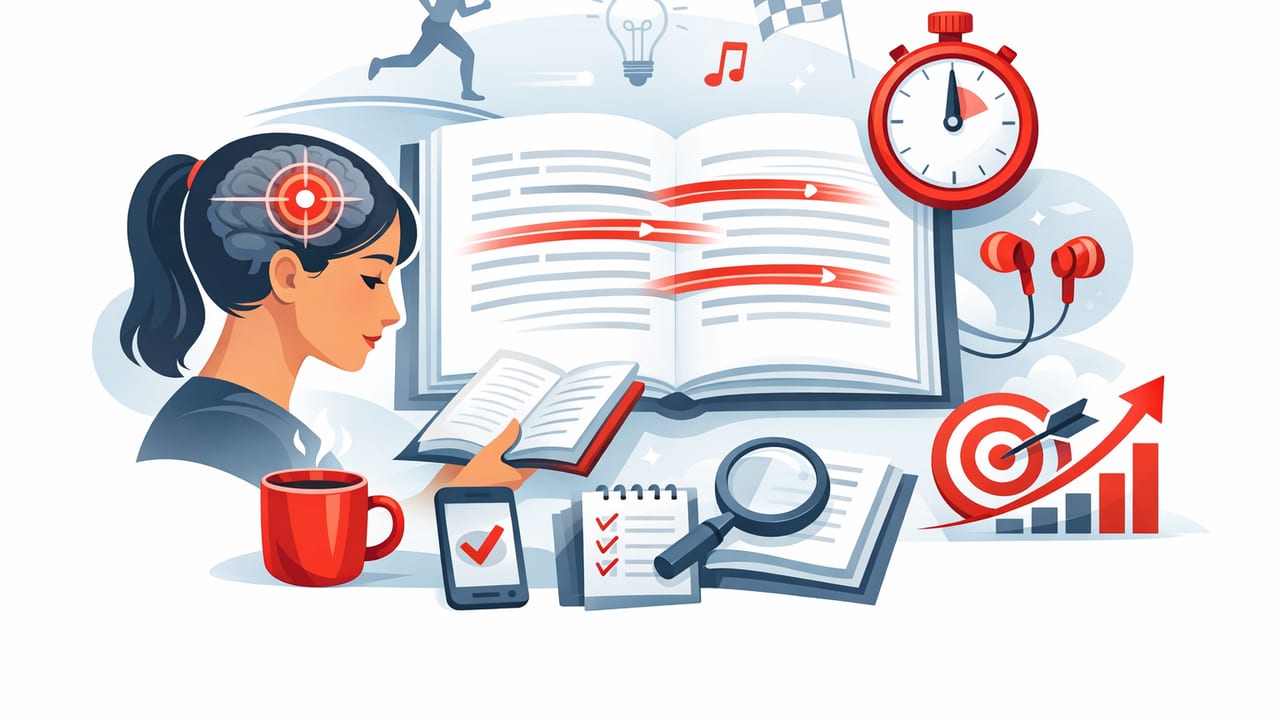
Most people try to read faster by pushing harder—skimming more aggressively, scrolling quicker, or setting unrealistic words-per-minute (WPM) goals. The result is predictable: your eyes move faster, but your mind drifts, comprehension drops, and you end up re-reading. The better approach is to treat speed and attention as a single skill: if you can improve reading speed and focus together, you’ll finish more pages with less mental friction.
This guide gives you a practical, research-aligned workflow for iPhone and iPad reading: how to measure your baseline, reduce distractions, apply speed techniques without losing meaning, and build a short daily routine you can sustain.
Why speed and focus rise (or fall) together
Reading speed isn’t just eye movement—it’s a coordination between visual tracking, attention, and working memory. When your attention slips, your brain stops integrating sentences into meaning. That forces re-reading, which slows you down far more than any “slow” pace ever would.
- Too slow can invite mind-wandering (your brain fills the gap with unrelated thoughts).
- Too fast can overload working memory (you can’t hold enough context to understand).
- The sweet spot feels focused, slightly challenging, and steady—like a jog you can maintain.
“Reading is not a passive act. It’s attention shaped over time.”
Step 1: Measure your baseline (accurately)
Before changing anything, get a realistic starting point. Pick a typical piece of material you actually read (news analysis, a report, a textbook chapter—something with paragraphs, not bullet-only pages).
- Time yourself for 5 minutes.
- Mark where you stop.
- Count words read (many apps/sites show word count; otherwise copy into a word counter).
- Calculate WPM: words ÷ minutes.
- Write a 2–3 sentence summary to verify comprehension.
If you want a simple formula you can reuse:
# WPM calculator
words_read = 1250
minutes = 5
wpm = words_read / minutes
print(wpm)
Target: aim to increase speed in small steps (5–10%) while maintaining your ability to summarize what you read.
Step 2: Set up your iPhone/iPad for sustained attention
To improve reading speed and focus, remove “attention leaks” first. On iOS, a few small changes can make long-form reading noticeably easier.
Use Focus mode like a reading “room”
- Create a dedicated Reading Focus that silences non-essential notifications.
- Allow only urgent contacts/apps if needed.
- Schedule it (e.g., weekdays 8–10am) or turn it on for timed reading sessions.
Choose a comfortable text layout
- Increase text size slightly to reduce squinting and micro-pauses.
- Prefer left-aligned text and adequate line spacing when available.
- Use Reader View in Safari to remove clutter on articles.
Reduce visual friction
- Use Night Shift or a warm color temperature for evening reading.
- Consider Reduce White Point if you get eye fatigue.
- Keep brightness stable (avoid auto-brightness swings in mixed lighting).
Step 3: Apply speed techniques that protect comprehension
Speed reading isn’t one trick. It’s a bundle of small skills that reduce wasted motion and improve attention control. Start with the basics below and stack them gradually.
Technique A: Preview before you read (30–60 seconds)
Previewing gives your brain a map, which improves focus because you know what to look for. Scan:
- Headings/subheadings
- First sentence of each paragraph (for argumentative writing)
- Charts, definitions, and summary sections
Payoff: fewer backtracks and better retention.
Technique B: Use a visual pacer (finger, stylus, or cursor)
Your eyes naturally stop and regress (jump backward). A pacer reduces those regressions by giving your attention a “rail” to follow.
- On iPad, track lines with Apple Pencil or a finger.
- On iPhone, scroll so the line you’re reading stays near the same vertical position.
Technique C: Read in meaningful chunks (not single words)
Instead of mentally pronouncing each word, train yourself to pick up 2–5 word chunks per fixation. You’re not “skipping” meaning—you’re grouping it.
- Look for phrase units: “as a result,” “in contrast,” “the main cause.”
- Let short function words ride along (the, and, of) rather than anchoring your gaze on them.
Technique D: Control subvocalization (don’t try to delete it)
Subvocalization—your inner voice—isn’t the enemy. For complex text, it can help. The goal is to prevent it from locking you into a slow, word-by-word pace.
- For easy text: slightly increase pace until the voice becomes more “summary-like.”
- For dense text: allow the inner voice, but use chunking and a pacer to avoid regressions.
Technique E: Insert micro-checkpoints
Every 1–2 pages (or every major section), pause for 10 seconds and ask:
- What is the author’s main claim so far?
- What evidence supports it?
- What would I tell someone in one sentence?
These checkpoints keep focus tight and reduce the need to re-read later.
A quick reference table: when to use what
| Technique | Best for | Goal |
|---|---|---|
| Previewing | Articles, reports, textbooks | Build a mental map to stay focused |
| Visual pacer | Any long-form reading | Reduce regressions and drifting |
| Chunking | Medium-easy prose | Increase WPM without skipping meaning |
| Micro-checkpoints | Dense or technical material | Protect comprehension and recall |
| Speed variation | Mixed difficulty documents | Go fast on easy parts, slow on hard parts |
The 20-minute daily routine to improve reading speed and focus
Consistency beats intensity. Use this short routine 5–6 days per week.
Minute 0–2: Set intention + remove friction
- Turn on Reading Focus.
- Open one document/article only (no tab hopping).
- Decide the outcome: “I want the thesis + 3 supporting points.”
Minute 2–4: Preview
Scan headings and first sentences. If it’s a PDF/report, find the executive summary, conclusion, or key figures.
Minute 4–16: Timed reading sprints (2 × 6 minutes)
- Use a visual pacer and chunk phrases.
- If your mind wanders, don’t punish yourself—restart the sentence once, then continue.
- Between sprints, take a 30-second break: look away, relax your eyes.
Minute 16–20: Comprehension checkpoint
- Write a 3-bullet summary (Notes app is fine).
- List one question you still have.
- If needed, re-read only the section that answers your question.
A 2-week progression plan (small increases, no burnout)
The most reliable way to get faster is gradual overload: push slightly, recover, then push again.
- Days 1–3: Baseline pace + perfect technique (pacer, preview, checkpoints).
- Days 4–7: Increase pace by 5% during the first sprint; keep the second sprint at baseline.
- Days 8–10: Increase both sprints by 5% if summaries remain accurate.
- Days 11–14: Add “speed variation”: go faster on easy paragraphs, slow down on dense ones.
Rule: If your summary quality drops for two sessions in a row, reduce speed by 5% and rebuild.
Track progress with a simple log
Tracking keeps you honest and helps you spot what actually improves focus (sleep? time of day? content type?). Use a lightweight table like this:
| Date | Material | Time (min) | Words | WPM | Summary quality (1–5) |
|---|---|---|---|---|---|
| — | — | — | — | — | — |
Common mistakes that block faster, more focused reading
- Trying to eliminate re-reading completely: strategic re-reading is normal; aim to reduce aimless backtracking.
- Chasing a single WPM number: good readers change speed based on difficulty.
- Ignoring comprehension: if you can’t explain it, you didn’t really read it.
- Reading in noisy contexts without boundaries: use Focus mode, headphones, or a fixed time block.
- Over-highlighting: highlight only what you’d put on a flashcard or in a one-paragraph recap.
Putting it all together
To improve reading speed and focus, start by protecting attention (Focus mode, cleaner layout), then build efficient mechanics (previewing, pacing, chunking), and finally lock in comprehension (micro-checkpoints and short summaries). The win isn’t just finishing faster—it’s finishing with clarity and less mental fatigue.
If you prefer reading workflows that include guided pacing or focused reading modes on iPhone and iPad, apps like FocalRead can be a convenient way to practice the routine consistently.