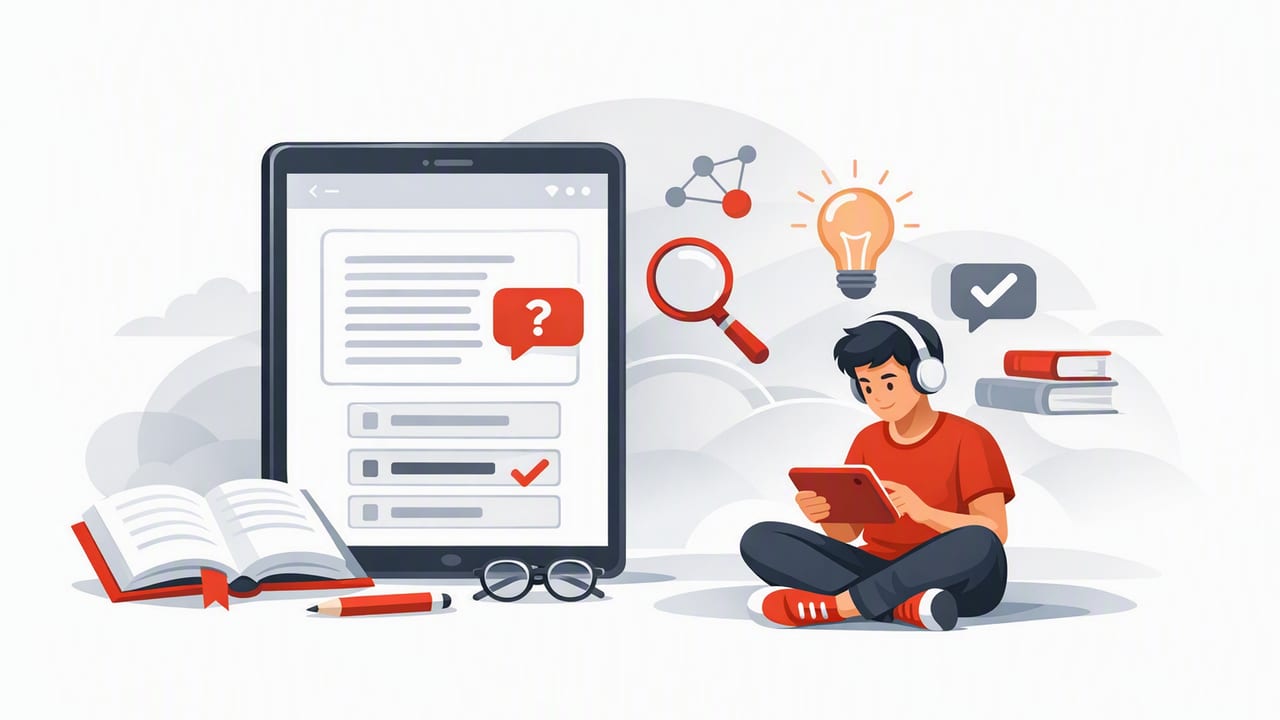
A good reading comprehension app doesn’t just help you get through more words—it helps you understand what you read, retain it, and use it later. On iPhone and iPad, that usually means combining three things: focus (staying on the page), pacing (reading at a sustainable speed), and active processing (notes, summaries, and recall).
If you’ve tried to “speed read” and ended up forgetting everything, the issue usually isn’t motivation—it’s that the app (or workflow) optimized for throughput instead of comprehension. This guide breaks down what to look for in a reading comprehension app, how to test it in under an hour, and how to build an iOS-friendly routine that improves both speed and understanding.
What a reading comprehension app should actually improve
Comprehension isn’t one skill. It’s a stack of smaller abilities that can be trained and supported by the right tools:
- Attention stability: staying with the text without checking other apps.
- Working memory load: not overloading your brain with long, dense sentences at high speed.
- Structure detection: noticing arguments, evidence, and headings (the “map” of the text).
- Recall: being able to restate the main points later.
Rule of thumb: If an app makes you finish faster but you can’t explain the key idea afterward, it’s not a reading comprehension app—it’s a skimming tool.
Key features to look for (and why they matter)
When evaluating any reading comprehension app on iOS, scan for these features first. They are strongly correlated with understanding, not just speed.
1) Flexible pacing controls (not just “fast mode”)
Look for granular control over speed and pacing behavior—ideally including:
- WPM sliders with small increments
- Pause on punctuation (commas, periods, paragraph breaks)
- Easy slow-down / speed-up mid-session
Comprehension drops sharply when your pace doesn’t match text difficulty. The best reading comprehension app lets you slow down for dense paragraphs and speed up for examples or familiar sections.
2) Focus modes that reduce eye wandering
On iPhone especially, eye movement can become inefficient: rereading lines, skipping, or losing your spot. Helpful focus features include:
- Guided reading (highlighting lines or phrases)
- RSVP / word-by-word display for short bursts
- Clean typography (spacing, margins, dark mode, font choices)
These tools don’t “replace” comprehension—they reduce friction so your mental energy goes into meaning.
3) Built-in active recall (notes, prompts, summaries)
The highest-leverage feature in any reading comprehension app is some form of active recall. If the app supports quick capture, you’re more likely to process ideas instead of passively consuming them.
- Highlighting that’s easy (and exportable)
- Sticky notes or margin notes
- Session summaries or prompts like “What was the main claim?”
If notes are clunky, you’ll skip them. If you skip them, comprehension becomes fragile.
4) Progress tracking that measures understanding (not just WPM)
WPM is motivating, but it can mislead you into racing. Better tracking includes:
- Time-on-task and reading streaks
- Completion by section (useful for textbooks and long PDFs)
- Comprehension checks (even simple self-ratings per session)
A strong reading comprehension app helps you answer: “Did I understand this?” not only “How fast was I?”
5) iOS-friendly input sources: web, PDFs, and pasted text
Real reading happens across formats. On iPhone and iPad, prioritize apps that can handle:
- Articles via share sheet
- PDFs with solid rendering and navigation
- Copy/paste for study notes, research excerpts, and emails
Feature checklist: what supports comprehension vs. what’s just flashy
Use this table as a quick filter when comparing apps.
| Feature | Why it helps comprehension | What to watch out for |
|---|---|---|
| Adjustable pacing + punctuation pauses | Matches speed to difficulty and sentence structure | Only fixed “levels” (too coarse) |
| Focus / guided reading modes | Reduces regressions and distraction | Overly aggressive animations that tire you out |
| Highlights + export | Supports review and spaced repetition | Highlights trapped inside the app |
| Notes or summaries | Forces active processing and better recall | Slow UI that interrupts reading too much |
| Distraction controls | Protects attention during deep reading | Requires many taps to start a session |
How to test a reading comprehension app in 45 minutes
You can evaluate a reading comprehension app quickly without overthinking it. Run this simple test on iPhone or iPad.
- Pick one text you actually need to understand (1,200–2,000 words). Avoid something too easy.
- Do 10 minutes at comfortable speed using the app’s default settings.
- Write a 5-sentence summary in Notes (no peeking). Include: main claim, 2 supporting points, 1 example, and why it matters.
- Increase speed by 15–25% and read 10 more minutes. Repeat the summary.
- Compare summaries: which one is clearer, more accurate, and more structured?
If faster reading produces worse summaries, that doesn’t mean you “failed.” It means your pace exceeded your comprehension threshold for that kind of text—and the app needs better pacing controls, pauses, or better note support.
A practical iPhone/iPad workflow for better comprehension
The best reading comprehension app is only half the equation. The other half is a workflow that makes understanding inevitable.
Step 1: Pre-read in 60 seconds
Before you start any timed or focused mode, skim the structure:
- Read headings and subheadings
- Look for bold terms, definitions, and figures
- Read the first and last paragraph
This reduces cognitive load because your brain has a “map” of what’s coming.
Step 2: Read in short intervals (and stop mid-clarity, not mid-fatigue)
For most people, comprehension improves with 15–20 minute blocks followed by a 1–2 minute reset. On iPhone, this matters even more because interruptions are common.
Step 3: Use a two-layer note system
Keep notes lightweight while reading, then consolidate afterward:
- Layer A (during reading): 3–5 quick highlights + 1 “?” question per section
- Layer B (after reading): a 5–7 sentence summary in your own words
This prevents note-taking from becoming a distraction while still forcing deep processing.
Step 4: Do a 30-second recall check
Close the text and answer:
- What was the author’s main point?
- What evidence did they use?
- What would I disagree with or test?
A reading comprehension app that makes it easy to jump back to key highlights will make this step painless.
Settings that usually improve comprehension (even when reading faster)
These are common iOS reading settings that tend to boost understanding without sacrificing too much speed:
- Enable punctuation pauses (especially on dense nonfiction).
- Increase line spacing or use a more readable font.
- Use dark mode at night to reduce fatigue.
- Turn on a subtle focus guide (line highlight or phrase chunking).
- Cap your speed for technical texts; aim for “smooth comprehension,” not maximum WPM.
Automation tip: start a distraction-free reading session on iOS
If you want your reading comprehension app to actually get used, reduce the friction to start. You can build a simple iOS Shortcut that:
- Turns on Focus mode
- Starts a timer (15 minutes)
- Opens your reading app
// Pseudo-steps for an iOS Shortcut (“Reading Sprint”)
1. Set Focus: Do Not Disturb (On for 20 minutes)
2. Start Timer: 15 minutes
3. Open App: (your reading comprehension app)
4. Show Notification: “Recall check when timer ends: main point + 2 supports.”
This kind of automation doesn’t make you smarter—it makes the smart behavior easier to repeat.
Common mistakes people make with reading comprehension apps
- Chasing WPM too early: speed gains should follow stable comprehension, not precede it.
- Reading without a purpose: set a goal like “extract 3 takeaways” or “answer these 2 questions.”
- Never reviewing highlights: retention comes from revisiting, even briefly.
- Using one mode for everything: articles, textbooks, and PDFs need different pacing and tools.
Quick rubric: which app is right for you?
Use this simple rubric when choosing a reading comprehension app:
- If you read for study: prioritize notes, export, PDF handling, and section navigation.
- If you read for work: prioritize share sheet import, clean formatting, and fast session start.
- If you read for volume: prioritize pacing controls, focus modes, and lightweight summaries.
Whichever category you’re in, the best choice is the one that helps you produce a better summary after reading—not the one that shows the biggest number.
Putting it together
A strong reading comprehension app on iPhone or iPad should make it easier to focus, pace yourself intelligently, and actively process what you read. When you evaluate options, test them with a real text and judge them by your recall—not by how fast the words move.
If you’re experimenting with iOS reading tools, you can apply the checklist above to any app you try; for example, FocalRead includes speed and focus-oriented modes that fit well into a comprehension-first workflow when paired with summaries and recall checks.