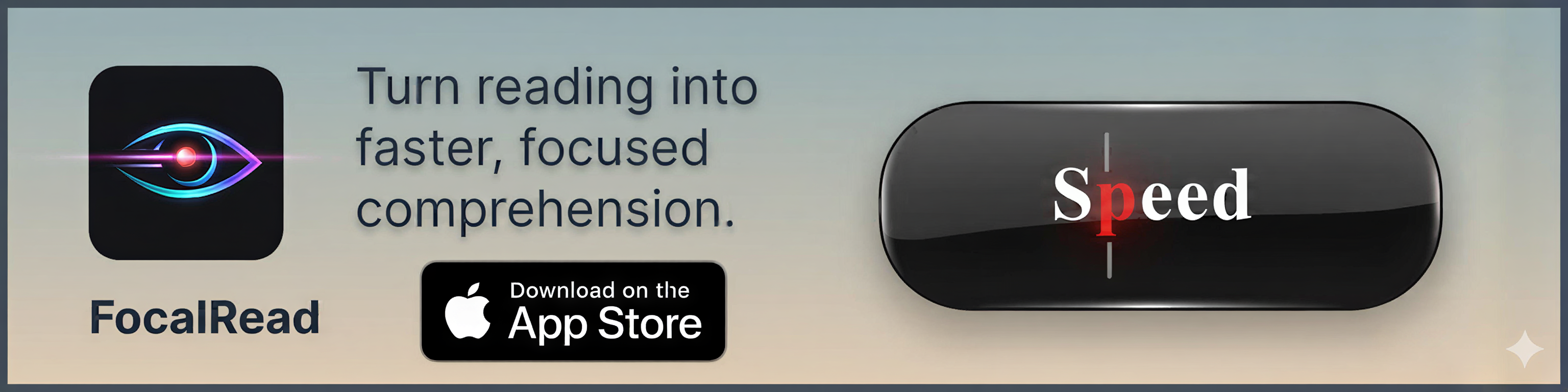
A one-word reader uses rapid serial visual presentation, or RSVP, to show text one word at a time in a fixed spot on the screen. Instead of moving your eyes across lines, you keep your gaze near the display as each word appears. This can make digital reading feel more focused, but it also changes how you encounter sentences, punctuation, and page structure.
The most useful way to practice RSVP reading is to treat it as a skill for selected material, not a shortcut for every kind of reading. Start at a pace you can follow, check what you understood, and adjust in small steps. The example and routine below can help you explore the format without assuming that a particular speed or result works for everyone.
What a one-word reader changes
In conventional reading, your eyes move across a line and return to the beginning of the next one. You can glance ahead, pause over a phrase, or scan back to clarify a point. An RSVP reader presents each word in sequence, often in the same screen position. This reduces the need to track lines, but it also removes some of the visual context that helps readers navigate a page.
The difference matters because words do not all carry equal weight. A short connector may be easy to process quickly, while an unfamiliar term, a qualification, or a number may deserve a pause. Punctuation can signal a boundary, but seeing one word at a time may make sentence structure less apparent. Reading speed settings therefore describe how quickly words appear; they do not measure understanding.
Choose material that suits RSVP practice
Begin with a short passage whose subject you already understand. A familiar explainer, a simple newsletter, or a few paragraphs from a general-interest article can be easier to follow than a dense textbook chapter. Familiarity lets you focus on the reading format rather than learning many new concepts at once.
RSVP is less suitable as a first practice text when the material depends on diagrams, equations, tables, footnotes, or comparisons across distant sections. It can also be a poor fit for close reading, legal or technical wording, poetry, or anything you need to quote precisely. In those cases, normal page reading makes it easier to inspect layout and revisit a specific line.
A practical one-word reader exercise
Use a passage of roughly 150 to 250 words. Before you begin, note its main question or topic. If your reader offers an adjustable pace, choose a setting that feels manageable rather than selecting an ambitious target. One reasonable experiment is to start a little below the pace at which you usually read comparable material silently. That is a personal starting point, not a universal WPM recommendation.
- Read one short section. Keep your attention on the displayed word, but do not force yourself to continue when you lose the meaning.
- Pause at a natural break. After a paragraph or a few sentences, state its main point in your own words before moving on.
- Check the details. Ask what evidence, example, or qualification supported that point. If you cannot recall one, revisit the passage at a slower pace or in its original layout.
- Adjust only one step. If the passage was clear and comfortable, try a modest increase on the next short section. If it felt rushed, lower the pace or switch back to ordinary reading.
- Compare formats. Read another passage of similar difficulty in the usual way. Notice which format helped you understand and stay attentive; do not judge only by how quickly the words appeared.
For example, imagine a 200-word article explaining why a city is changing a bus route. At a comfortable RSVP pace, you might finish the passage and summarize the change, the reason for it, and who is affected. If you remember the general topic but miss the date or the neighborhoods involved, the pace may be too demanding for that text. Lower it, reread the relevant section, and check those details again. The point is not to hit a preset speed; it is to find out whether the format is serving the reading task.
Use comprehension checks, not WPM alone
Words per minute can help you describe a setting or compare attempts, but it is only useful alongside a comprehension check. A faster display is not automatically a better reading session. If you finish quickly but cannot explain the argument, identify the main steps, or remember what action a document requires, the pace did not meet your goal.
Keep checks brief and specific. After a passage, try answering questions such as:
- What was the main point?
- What was one supporting fact or example?
- Was there a condition, exception, or contrast I need to remember?
- Do I need to act on or verify anything in the source?
For study materials, add a retrieval step: close the text and write two or three points from memory, then reopen it to check accuracy. For work documents, verify names, dates, figures, and instructions directly in the original. These checks help reveal when to slow down, reread, or change formats. They are not a formal test of memory or a guarantee of retention.
Build a short, repeatable practice routine
Consistency is more useful than trying to make every session a speed challenge. A simple routine might take 10 to 15 minutes:
- Minute 1: Choose a short, appropriate passage and set a clear purpose, such as learning the article’s main claim.
- Minutes 2–6: Read a section in RSVP at a comfortable pace. Pause at a paragraph break and summarize.
- Minutes 7–10: Continue at the same pace or test a small adjustment, then check the important details.
- Final minutes: Record the pace setting, material type, and whether your summary was accurate. Note if you felt focused or strained.
Repeat the routine with similar kinds of material before drawing conclusions. One easy article and one complex report are not a fair comparison. A brief log can show patterns, such as being comfortable with familiar prose but needing more time for technical vocabulary. Use that information to choose a pace and format for the next session, not to set a universal target.
Common RSVP practice mistakes
Increasing the pace too quickly
If you raise the speed whenever a passage feels easy, you may reach a point where you recognize words without connecting them. Increase gradually, and return to the previous setting when comprehension becomes unreliable. There is no requirement to keep increasing.
Ignoring punctuation and sentence structure
A sequence of words can make clauses and transitions harder to see. Give yourself time at punctuation or paragraph breaks when needed. If your reader provides controls for pacing or pausing, use them to support comprehension rather than treating uninterrupted playback as a goal.
Using RSVP for every reading task
One-word presentation can help reduce the need to scan a screen, but it is not a replacement for all reading. Use page view when you need to compare sections, examine a chart, annotate a passage, or check exact wording. Moving between formats is a practical choice, not a failure to practice.
Confusing attention with understanding
A fixed visual point may feel more focused, yet focus alone does not confirm that you understood a text. A short recap or detail check can reveal gaps that a smooth reading session hides.
When to stop or switch back to page reading
Change formats if you are repeatedly losing the thread, feeling eye strain, or struggling to understand sentence relationships. Also switch when the task requires close analysis, cross-referencing, or precise verification. You can read an overview with RSVP and return to the page for a difficult paragraph; the two approaches can complement each other.
Comfort matters. Adjust text size, screen brightness, and session length to suit your reading conditions, and take a break if your eyes feel tired. If one-word presentation consistently makes reading harder, ordinary scrolling or page-based reading may simply be a better fit for you.
Make RSVP a tool, not a target
Practice RSVP reading by pairing a manageable pace with a clear comprehension check. Start with familiar, straightforward text, summarize what you read, and change the setting only when the meaning remains clear. Use conventional reading whenever layout, detail, or careful analysis matters. Over time, these small experiments can help you decide which tasks suit a one-word reader and which do not.
If you want more guidance on reading efficiently, FocalRead’s guide to how to read faster offers additional strategies. The aim is not to force every passage into a faster format, but to choose an approach that fits your purpose and supports understanding.