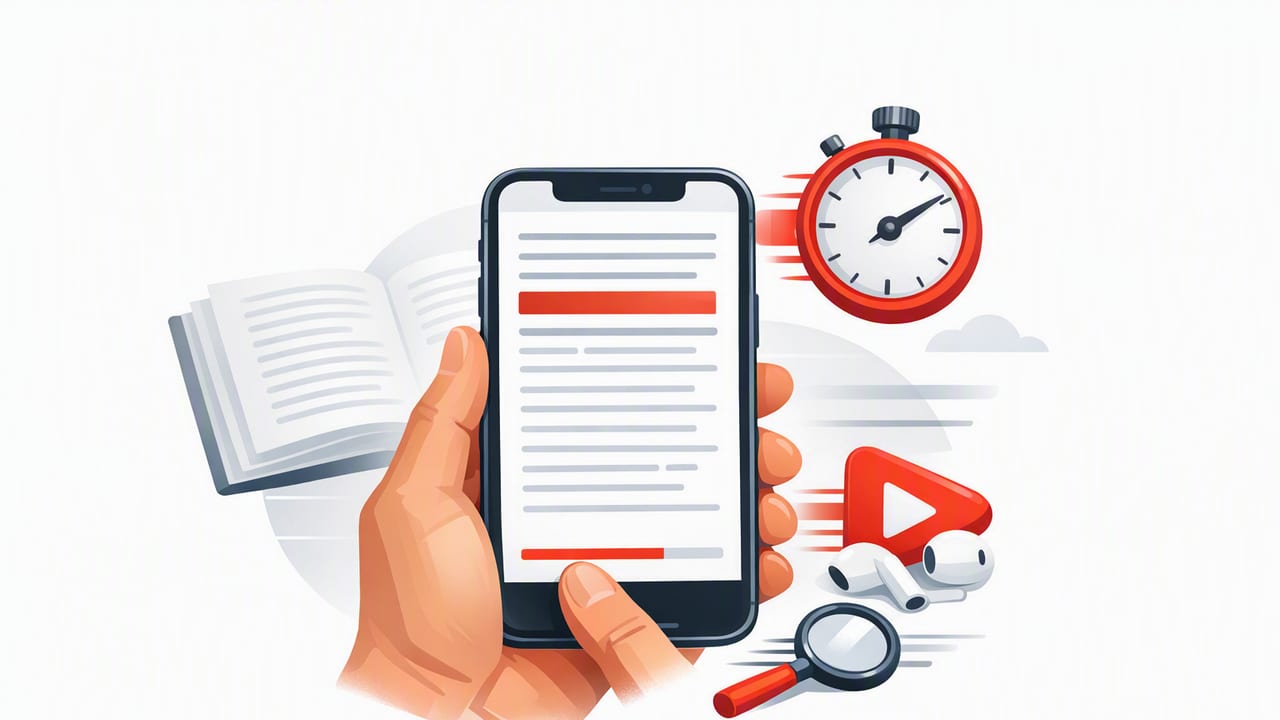
Reading on a phone is convenient, but it’s also engineered to be distracting: notifications, tiny text, endless scrolling, and multitasking temptations. The good news is that you can learn how to read faster on iPhone without turning reading into a stressful race. The goal is efficient comprehension: absorbing the main ideas quickly, keeping focus, and retaining what matters.
This guide walks you through (1) iPhone settings that make fast reading easier, (2) the most effective speed reading techniques for small screens, and (3) a practical 20-minute training plan you can repeat.
What “reading faster” actually means on iPhone
On a phone, speed is often limited less by intelligence and more by friction: poor formatting, visual fatigue, constant context-switching, and untrained habits like re-reading lines. Faster reading on iPhone typically comes from three upgrades:
- Reduce distractions so your attention stays on the text.
- Improve visual flow so your eyes move efficiently.
- Use better processing strategies (skimming, chunking, and structure-first reading).
Step 1: Optimize iPhone settings for faster reading
Before practicing techniques, make reading on iPhone easier on your eyes and attention. Small improvements here compound every time you read.
Turn on Focus and tame notifications
- Settings → Focus: create a “Reading” Focus that silences most apps and allows only essential contacts.
- Disable Lock Screen and Notification badges for high-distraction apps during reading sessions.
Use Reader mode (Safari) for cleaner text
Busy web pages slow you down. In Safari, tap aA in the address bar and choose Show Reader (when available). Then adjust font size and background for comfort.
Adjust text size and contrast to reduce fatigue
- Settings → Display & Brightness: try a slightly warmer display (Night Shift) in the evening.
- Settings → Accessibility → Display & Text Size: increase text size if you squint or lose your place.
- Experiment with Dark Mode vs. light backgrounds; choose what keeps you alert and reduces glare.
Reduce motion (optional, but helpful)
If animations pull your attention, use Settings → Accessibility → Motion → Reduce Motion. Less visual noise can mean smoother focus.
Make one “reading home screen”
Speed reading isn’t only a technique; it’s an environment. Put reading apps, Notes, and your “read later” tool on one screen, and move social apps off your first page. The fewer taps to start reading, the more likely you’ll do it.
Step 2: Use faster reading techniques that work on a small screen
Many classic speed reading tips were designed for books and paper. On iPhone, you want techniques that reduce scrolling and minimize eye-tracking mistakes.
Technique A: Preview first (30–60 seconds)
Previewing is the fastest way to boost comprehension while increasing speed. Before reading the full text, scan for structure:
- Title, subtitle, author, and date (context matters).
- Headings and subheadings (they reveal the argument).
- Bulleted lists, bolded terms, charts, and summaries.
Why it works: Your brain reads faster when it knows what it’s looking for. Previewing creates a mental “map,” reducing backtracking.
Technique B: Read in chunks (stop reading word-by-word)
On phones, word-by-word reading is common because the line length is short and scrolling breaks rhythm. Train yourself to see 2–5 words at a time (a phrase), not single words. Start with short phrases and expand as you get comfortable.
Quick drill: In each sentence, try to “grab” the meaning in 3 eye stops (beginning / middle / end). If you can summarize the sentence, your chunking is working.
Technique C: Reduce regression (unnecessary re-reading)
Regression is when your eyes jump backward to re-check earlier words. A little regression is normal, but constant backtracking destroys speed. Common causes on iPhone:
- Reading when tired
- Unclear purpose (“Why am I reading this?”)
- Dense formatting (ads, popups, narrow columns)
Fix: set a purpose before you start: “I want the 3 main points and 1 actionable step.” Purpose reduces the urge to re-read everything.
Technique D: Use guided pacing (without rushing)
Guided pacing means using a steady rhythm to prevent drifting. On iPhone you can do this by:
- Scrolling at a controlled pace (not too fast, not too slow)
- Following the text with your thumb lightly (as a visual anchor)
- Using reading modes that present text in a controlled stream
Guided pacing works because it reduces decision fatigue: you don’t constantly decide where to look next.
Technique E: Two-pass reading for long articles
If an article is long or technical, don’t force yourself to read every paragraph at the same speed. Use two passes:
- Pass 1 (fast): headings, first sentences, key examples, conclusion.
- Pass 2 (selective): slow down only where you need details, formulas, or evidence.
This approach often beats “slow-read everything” in both speed and understanding.
Step 3: A 20-minute iPhone reading speed workout (repeatable)
Consistency matters more than heroic sessions. Here’s a simple routine designed for iPhone reading.
Minute 0–2: Set your goal and remove friction
- Turn on your Reading Focus.
- Open the article/document in a clean view (Reader mode if possible).
- Goal: “I’m extracting the thesis + 3 supporting points.”
Minute 2–5: Preview
Scan headings, bullets, and any summary. Decide what you can skip. This is not cheating; it’s strategy.
Minute 5–15: Timed read (controlled pace)
Read with chunking and guided pacing. When you feel the urge to regress, pause for a second and ask: Did I lose meaning, or did I lose confidence? Often it’s confidence. Keep going unless comprehension clearly breaks.
Minute 15–18: Recall (no looking)
In Notes, write:
- 1 sentence: the main point
- 3 bullets: key takeaways
- 1 question: what you still don’t understand
Recall is a powerful “comprehension audit.” It teaches your brain that reading is for meaning, not just finishing.
Minute 18–20: Review only what matters
Now re-open the text and re-read only the sections that answer your question or strengthen your takeaways. This is targeted regression (useful), not automatic regression (wasteful).
Common mistakes that keep you reading slowly on iPhone
- Reading without a purpose: you’ll re-read because nothing feels “captured.”
- Trying to speed up before you stabilize comprehension: pace comes after clarity.
- Reading in distracting environments: even a few interruptions can cut effective speed in half.
- Using tiny text: squinting increases fatigue and regression.
- Never measuring progress: what you don’t measure, you won’t improve.
Benchmarks: speed vs. comprehension (practical targets)
You don’t need extreme words-per-minute to get major benefits. Use this table as a realistic guide for iPhone reading, especially for articles and study materials.
| Level | Typical WPM Range | What it feels like | Best use |
|---|---|---|---|
| Baseline | 150–250 | Careful, frequent re-reading | Dense or unfamiliar topics |
| Efficient | 250–400 | Steady pace, good recall | Most articles, work docs |
| Fast (selective) | 400–600 | More skimming, structure-first | Research, scanning, revision |
| Very fast (specialized) | 600+ | High pace, relies on previewing | Familiar material, overview passes |
Tip: If you increase speed but your recall drops, you didn’t fail—you found your current limit. Train just below that limit and expand gradually.
A simple way to measure your reading speed on iPhone
You can estimate WPM (words per minute) without special equipment:
- Pick a text with a known word count (many articles show it; or copy into a tool that counts words).
- Set a timer for 5 minutes.
- Read normally (or with your chosen technique).
- Stop at 5 minutes and note how many words you read.
WPM = words_read / minutes
Example: 1,500 words in 5 minutes = 300 WPM
Then do a 30-second recall: write the thesis and 3 points. If you can’t, slow down slightly or preview more.
Build a sustainable iPhone reading habit (so speed sticks)
Speed gains last when reading becomes a routine. Keep it simple:
- Schedule: 10–20 minutes daily beats 2 hours once a week.
- Content mix: alternate easy and hard texts to avoid burnout.
- One capture tool: Notes, a highlights app, or a single notebook system.
- One metric: track either WPM or “articles finished per week,” plus a quick recall score (0–3).
Rule of thumb: If you can’t summarize it, you didn’t really read it—no matter how fast you scrolled.
When a reading app can help (and what to look for)
If you read frequently on iPhone, the right reading tool can reduce friction by offering cleaner layouts, guided pacing modes, and progress tracking. Look for features like:
- Distraction-free reading views
- Adjustable speed controls for paced reading
- Comprehension-friendly settings (pause, rewind by sentence/phrase)
- WPM tracking and short drills
If you want a lightweight way to practice paced reading on iOS, an app like FocalRead can fit into the routine above—especially for short daily drills.