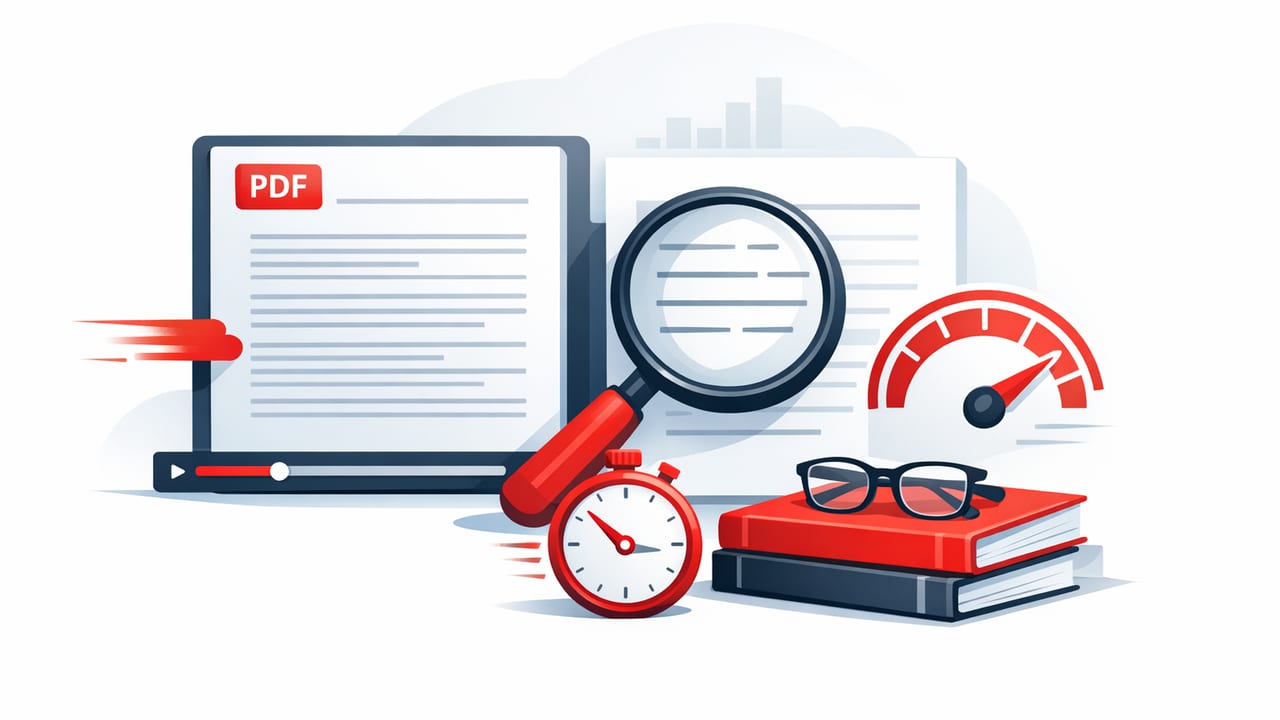
PDFs are where reading speed goes to die: dense formatting, tiny fonts, two-column layouts, footnotes, and charts that constantly break your flow. If your goal is to read PDF files faster on an iPhone or iPad without turning your brain into a highlight machine, you need a repeatable workflow—not just “read quicker.”
This guide gives you a practical, iOS-friendly system that improves speed and comprehension. It’s built for students, professionals, and anyone who reads reports, papers, manuals, or course packets as PDFs.
Why PDFs feel slow (and what to do about it)
Most speed reading advice assumes a clean, reflowable text layout (like an article). PDFs often resist that. The biggest speed killers are:
- Visual friction: small font, narrow margins, inconsistent spacing.
- Navigation friction: you lose time jumping between headings, figures, and references.
- Comprehension friction: technical terms and dense sentences require more “meaning checks.”
The fix is to reduce friction first, then use a reading strategy that matches your goal (overview vs. deep understanding).
Step 1: Prepare the PDF for faster reading
Before you read, spend 60–120 seconds setting the document up. This is the highest-ROI habit for anyone trying to read PDF files faster.
On iPhone and iPad: quick setup checklist
- Choose a comfortable view: on iPad, try two-page vs. single-page view; on iPhone, single-page is usually faster.
- Set a consistent zoom: zoom so body text fills most of the screen. Avoid constant pinch-zooming.
- Turn on thumbnails/bookmarks: use the sidebar to jump sections instead of scrolling blindly.
- Search first: use in-document search for key terms (your assignment question, a concept, a definition).
Tip: If the PDF is scanned (no selectable text), run it through OCR in a PDF tool so search works. Searchability alone can cut reading time dramatically.
Step 2: Use a 3-pass reading method (fast, then deep)
Trying to read everything at the same speed is the fastest way to stall. Use three passes:
Pass A: Map the document (2–5 minutes)
Your only job is to learn the structure. Jump using headings and the table of contents. Look for:
- Abstract / executive summary
- Section headings
- Conclusion / recommendations
- Figures and tables
Comprehension stays high when your brain knows where it is. A quick “map” reduces rereading and keeps you oriented.
Pass B: Skim for the argument (5–12 minutes)
Now read selectively. Focus on:
- First and last paragraph of each section
- Topic sentences (often the first sentence of a paragraph)
- Any sentence with numbers, claims, or definitions
If you’re reading a research paper, skim the methods and jump to results/discussion unless methods are your priority.
Pass C: Targeted deep reading (as needed)
Only after you understand the document’s direction do you slow down for the hardest parts: dense explanations, proof steps, detailed requirements, or tricky definitions.
Step 3: Choose the right “speed mode” for the PDF
Speed reading isn’t one tool; it’s a set of tools. Use the mode that matches the page type.
| PDF content type | What slows you down | Fastest effective approach |
|---|---|---|
| Plain text paragraphs | Subvocalization, regressions | Faster pacing + fewer backtracks; short meaning checks |
| Two-column layouts | Losing your place | Read one column at a time; zoom to column width |
| Figures, charts, tables | Visual interpretation | Read caption first; then scan axes/labels; then interpret |
| Legal/technical specs | High precision language | Slow down; annotate requirements; summarize each clause |
Step 4: Stop rereading—use “micro-recalls” instead
Most people lose time because they reread paragraphs “just to be safe.” That feels responsible, but it’s usually inefficient. Replace rereading with a faster loop:
- Read a short chunk (one paragraph or a half-page).
- Pause for 3–5 seconds.
- Ask: “What was the point?” Say it in one sentence.
- If you can’t, reread only the topic sentence and the key definition/claim.
This preserves comprehension while still letting you read PDF files faster overall.
Step 5: Use a consistent annotation system (lightweight, not noisy)
Highlighting everything slows you down and ruins review. Use a simple code:
- Highlight: only definitions, key claims, and “examable” statements.
- Underline: the one sentence that summarizes a section.
- Margin note: 3–7 words that label the paragraph (e.g., “cause of error,” “main limitation”).
- Question mark: confusion you’ll resolve later (don’t stop immediately unless it blocks understanding).
On iPad, a stylus makes this fast. On iPhone, keep it minimal—too much precision work is slower on a small screen.
Step 6: Handle dense pages with a “compression” technique
When a page is painfully dense, don’t force your normal pace. Use compression:
- Extract nouns/verbs: scan and circle the key concepts and actions.
- Reduce to bullets: rewrite the paragraph into 2–4 bullets in your notes.
- Re-read once, fast: now the original paragraph will feel simpler and you’ll move on quicker.
This is especially effective for textbooks, standards documents, and academic PDFs.
Step 7: Make PDFs easier to read on iOS (small setting wins)
These are small changes that add up over a long document:
- Brightness and contrast: increase slightly to reduce eye strain (especially for gray scanned PDFs).
- Reduce distractions: use Focus modes (e.g., Study/Work) to prevent notification-driven context switching.
- Use Split View (iPad): PDF on one side, notes on the other to avoid app switching.
- Prefer landscape for charts: rotate for tables/figures so you aren’t panning constantly.
Step 8: A repeatable 25-minute “read faster” PDF session
If you want a concrete routine, run this 25-minute block:
- 2 minutes: map the PDF (Pass A).
- 8 minutes: skim the argument (Pass B).
- 12 minutes: deep-read 2–4 key sections (Pass C), using micro-recalls.
- 3 minutes: write a “one-paragraph brief” of what you learned.
Repeat with a short break. This is more sustainable than trying to sprint for an hour and burning out.
Step 9: If the PDF is long, create an “index note” for fast return
Long PDFs become useful only if you can re-enter quickly. Create a short index note in your notes app:
- Purpose (1 line)
- Key sections to revisit (with page numbers)
- Top 5 terms (so you can search later)
- Open questions
That note turns future rereading into targeted searching, which is one of the fastest ways to read PDF files faster over time.
Common mistakes that slow you down (and the fix)
Mistake: Reading line-by-line like it’s a novel
Fix: PDFs are often reference documents. Use headings, captions, and summaries as your “rails.”
Mistake: Highlighting as a substitute for understanding
Fix: Highlight less, recall more. If you can summarize, you don’t need fluorescent confidence.
Mistake: Treating confusion as an emergency
Fix: Mark the spot, keep moving, and resolve confusion during a second pass—unless it blocks everything after it.
A tiny template you can copy for better comprehension
Paste this into your notes for any PDF:
PDF Brief
- Goal (why am I reading this?):
- Main claim / takeaway:
- 3 supporting points:
  1)
  2)
  3)
- Terms to remember:
- Questions to resolve:
- Pages to revisit:
This keeps you oriented and reduces the urge to reread.
Putting it all together
To read PDF files faster on iPhone or iPad, start by reducing friction (zoom, search, navigation), then use a 3-pass approach, replace rereading with micro-recalls, and annotate lightly but intentionally. The goal isn’t to “go fast” every second—it’s to spend time only where it produces understanding.
If you prefer an app-based approach for paced reading modes and focused practice on iOS, you can also explore tools like FocalRead as part of your workflow.