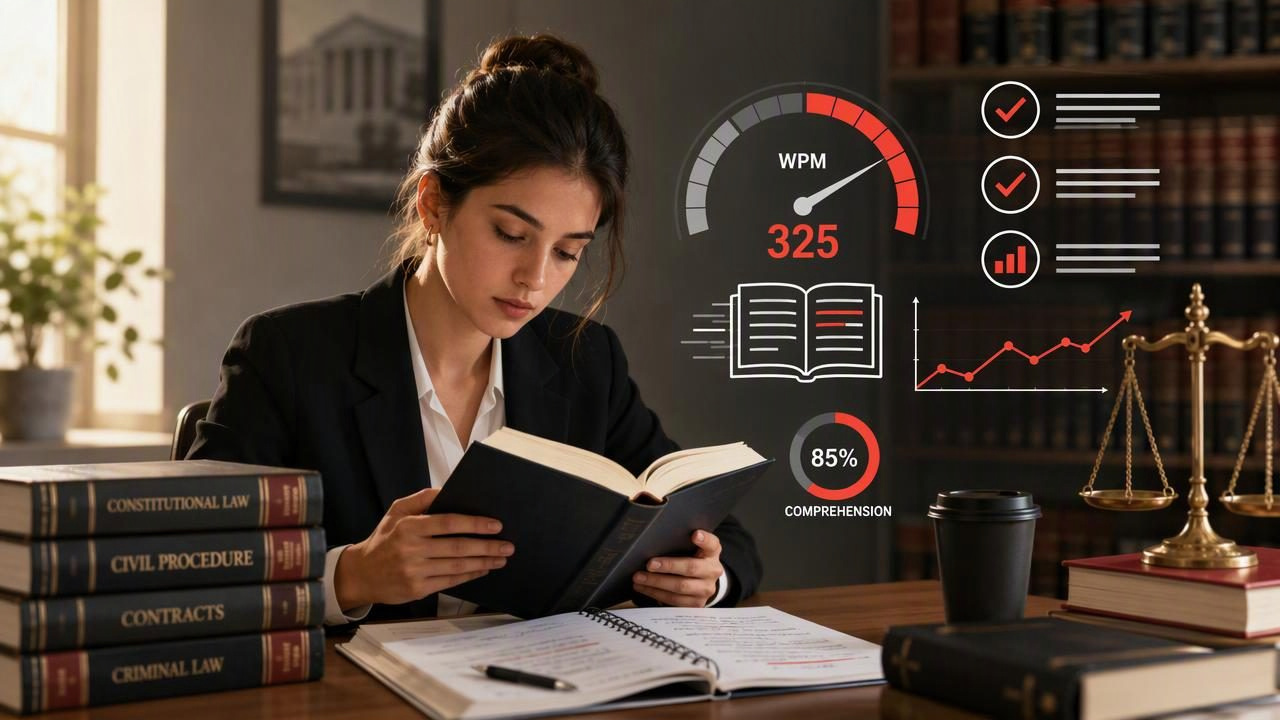
A reading speed test for law students can reveal more than how many pages you finish in an hour. Legal reading requires you to identify rules, follow procedural history, distinguish holdings from dicta, notice qualifying language, and connect a case to the issue in front of you. A high words-per-minute score is not useful if you cannot accurately explain the court’s reasoning afterward.
The goal, then, is not to chase a single “ideal” reading speed. It is to establish a reliable baseline, test different types of legal material, and track whether faster reading still supports sound comprehension. This guide explains how to run a practical test, calculate your words per minute (WPM), score your understanding, and use the results to improve your study routine.
Why Law Students Need a Different Reading Speed Test
Reading a news article, a textbook chapter, and an appellate opinion are different cognitive tasks. In a casebook, one short paragraph may contain a rule limitation that changes the outcome. In a statute, definitions and cross-references may matter more than the surrounding prose. In a law review article, the central task may be evaluating an argument rather than simply locating a holding.
For that reason, a useful legal reading test measures two things:
- Reading rate: how many words you read per minute.
- Comprehension: how accurately you can recall, organize, and apply what you read.
These measures should stay together. If your WPM rises but your case brief becomes incomplete or you miss a key exception, the faster pace may not be appropriate for that material.
What You Need Before You Begin
You do not need specialized testing equipment. Prepare a timer, a word count, a quiet setting, and a short set of questions. Choose material that resembles what you actually read during the semester. A realistic test passage is usually better than a generic online speed-reading passage because it reflects the density and vocabulary of your work.
For a first test, select a passage of roughly 800 to 1,200 words. Good options include:
- A section of an assigned appellate opinion
- A casebook note or explanatory section
- A short statutory provision with commentary
- A legal memo or journal article excerpt
Avoid passages you have already read closely. Familiarity can inflate your result because you are recognizing information rather than processing it for the first time.
Keep the Testing Conditions Consistent
To make comparisons meaningful, use similar conditions each time. Read at the same time of day when possible, silence notifications, and do not stop to look up every unfamiliar term during the baseline test. Mark confusing terms or passages instead. In ordinary study, you should absolutely verify authorities and definitions; during a short diagnostic test, frequent interruptions make it difficult to measure your initial reading flow.
How to Run a Reading Speed Test for Law Students
- Choose one unfamiliar legal passage. Record the total word count. Many document editors provide this automatically.
- Preview the task. Write down what you will need to identify, such as facts, issue, rule, reasoning, holding, and policy implications.
- Set a timer and read normally. Do not deliberately race. Use the pace you would use when preparing for class or outlining.
- Stop when you finish. Record the time in minutes and seconds.
- Put the passage away. Answer your questions without looking back.
- Score both rate and comprehension. Review the passage only after you have completed your answers.
For a more useful baseline, repeat the process on three separate passages over a week. One test may be affected by fatigue, a particularly technical topic, or an unusually clear judicial opinion.
Calculate Your Legal Reading Speed
Use this simple formula:
Words per minute (WPM) = Total words read ÷ Total time in minutesIf your timer shows seconds, convert them to a fraction of a minute. For example, 8 minutes and 30 seconds is 8.5 minutes.
Example: A Constitutional Law Case Reading Test
Imagine you read a 1,020-word excerpt from an unfamiliar constitutional law opinion. You finish in 8 minutes and 30 seconds.
1,020 words ÷ 8.5 minutes = 120 WPMYour baseline reading rate for that passage is 120 WPM. That number is only the first part of the result. Next, assess whether you retained the information needed for legal analysis.
| Test element | Example result | What it tells you |
|---|---|---|
| Passage length | 1,020 words | Provides the numerator for WPM. |
| Reading time | 8.5 minutes | Captures your initial reading pace. |
| Reading speed | 120 WPM | A baseline for similar material, not a universal score. |
| Comprehension score | 8 out of 10 | Shows whether your pace supported useful recall. |
Build a Comprehension Check That Reflects Legal Work
Multiple-choice questions can be helpful, but law students also need to reconstruct analysis. A stronger comprehension check asks you to explain the passage in your own words. Use five to ten questions, depending on the passage length.
For a judicial opinion, include prompts such as:
- What are the legally relevant facts?
- What question did the court decide?
- What rule or test did the court use?
- What was the holding?
- What facts or policy reasons drove the court’s reasoning?
- What limitation, exception, or unresolved issue should you remember?
- How might this case be used in a hypothetical?
Assign one point for each substantially correct response. For the example above, an 8/10 score suggests that 120 WPM may be workable for a first pass through that kind of constitutional law material. If the missing answers concern the holding or rule, however, the score deserves closer attention than if you missed a minor factual detail.
A useful legal reading pace is the fastest pace at which you can still identify, explain, and use the important parts of the text.
Track Results by Material Type
Do not combine every result into one overall average. Your rate will likely vary across subjects and formats, and that is normal. A clear torts opinion may be easier to process than a dense tax statute. Instead, maintain separate categories in a spreadsheet or notes app.
| Material type | Track | Why it matters |
|---|---|---|
| Appellate cases | WPM, issue/rule/holding score | Tests case-briefing accuracy. |
| Statutes and regulations | WPM, definitions and exceptions score | Highlights precision and cross-reference demands. |
| Casebook notes | WPM, doctrine summary score | Measures conceptual understanding. |
| Law review articles | WPM, thesis and evidence score | Measures argument evaluation. |
After several entries, look for patterns. Perhaps you read opinions efficiently but slow down substantially in statutory interpretation. That is not necessarily a problem to eliminate. It may show where careful parsing is appropriate or where you need a different annotation strategy.
How to Improve Your Score Without Sacrificing Accuracy
Once you have a baseline, adjust one variable at a time. Increasing speed and preserving comprehension is usually a gradual training process, especially with demanding legal texts.
Read With a Purpose Before Starting
Before opening a case, ask what you need from it. Are you preparing for cold calling, extracting a rule for an outline, or comparing the case with another authority? A clear objective prevents you from treating every sentence as equally important.
Use a Two-Pass Method for Longer Assignments
For some readings, a fast first pass can establish structure: parties, procedural posture, issue, disposition, and major headings. A slower second pass can focus on the rule language, reasoning, and difficult sections. This is not a shortcut around careful reading. It is a way to allocate your attention deliberately.
Reduce Unnecessary Regressions
Rereading is sometimes essential, particularly when a sentence contains a test, exception, or citation chain. But habitual backtracking can interrupt concentration. When you notice yourself rereading without a specific question, finish the paragraph first, then decide whether the passage requires review.
Practice in Short, Measured Sessions
Try two or three sessions of 10 to 15 minutes each week with comparable material. Record WPM and comprehension after each session. If comprehension drops meaningfully at a higher pace, lower the speed for the next session. The record is more valuable than a one-time personal best.
Limitations of Reading Speed Tests
A reading speed test is a diagnostic tool, not a verdict on your ability or potential. It cannot fully capture legal judgment, synthesis across authorities, or the time needed to write a persuasive analysis. It also does not account for the extra work required when you must verify citations, consult a treatise, or research an unfamiliar doctrine.
Be cautious when comparing your score with someone else’s. Different passages, prior knowledge, sleep, device size, and test conditions all affect results. A lower WPM on a complex statutory scheme may reflect careful and appropriate reading rather than a weakness.
Most importantly, do not optimize for speed when the task requires precision. Exam instructions, contracts, statutory exceptions, and binding rule statements deserve deliberate attention. Your aim is adaptable reading: moving efficiently through straightforward material while slowing down when the legal stakes of a phrase demand it.
Turn Your Results Into a Better Study Habit
Use your first three tests to create a starting profile. Identify the materials where you retain information comfortably, the materials that require a slower pace, and the conditions that help you focus. Then retest every few weeks using new passages of similar difficulty.
If you prefer practicing paced digital reading on an iPhone or iPad, FocalRead’s guide to reading faster offers a useful overview of pairing speed practice with comprehension checks. Whatever tool you choose, keep the same standard: faster reading only counts when you can explain what you read and apply it when it matters.