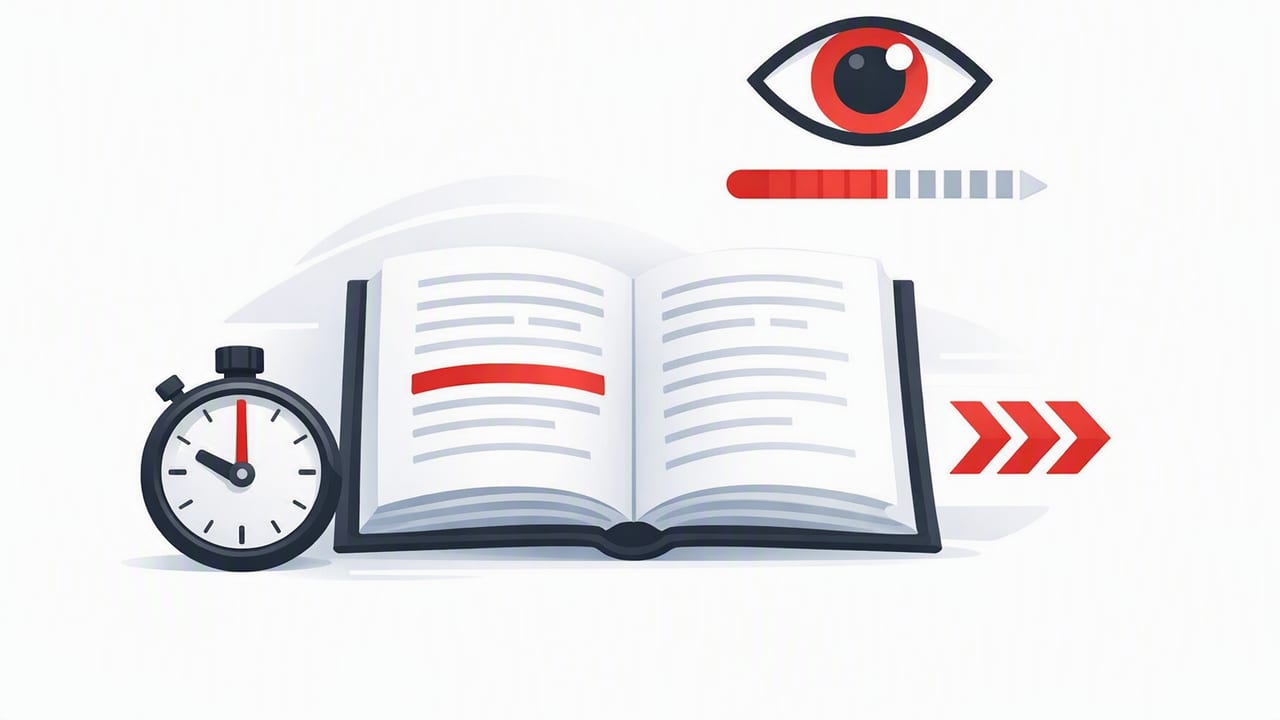
A reading speed trainer is not just a timer that pushes you to read faster. Used well, it’s a structured way to improve three skills at once: speed (words per minute), attention (less mind-wandering), and comprehension (what you can accurately recall and apply).
This guide lays out a practical, measurable training system you can use with digital text on an iPhone or iPad (or any device). You’ll learn what to track, which drills work, how to choose difficulty, and how to avoid the most common “faster-but-fuzzier” trap.
What a reading speed trainer actually trains
Reading speed is limited by several bottlenecks. Training works best when you know which one you’re targeting.
- Subvocalization: silently pronouncing every word. Reducing it can increase speed, but eliminating it completely isn’t required (or realistic) for comprehension-heavy material.
- Regressions: unnecessary backtracking (re-reading lines). A trainer helps reduce regressions by stabilizing pacing and attention.
- Fixation efficiency: how many words you can take in per eye stop. On screens, layout and pacing tools can encourage wider “chunks.”
- Working memory load: complex sentences or unfamiliar topics slow you down. Training helps you adjust speed instead of forcing one pace for everything.
- Focus control: the biggest hidden limiter. Even a small reduction in distractions can boost effective WPM more than a new technique.
The 3 metrics you should track (and one you shouldn’t)
Most people track only WPM, then wonder why comprehension slips. Use this simple scorecard instead:
- Baseline WPM: your comfortable reading speed for a typical article.
- Comprehension score: a quick self-test after reading (details below).
- Consistency: how often you train (minutes per week).
Don’t over-track: Avoid obsessing over the highest WPM you can “survive” for 30 seconds. What matters is sustainable speed with recall.
A simple comprehension score (takes 60 seconds)
After a passage, answer these without looking back:
- 1-sentence summary: What was the core claim?
- 3 bullet facts: What were the key supporting points?
- 1 application: How would you use this info (in study/work)?
Rate yourself from 1–5:
- 5 = accurate, specific, confident
- 3 = general idea, missing details
- 1 = vague or incorrect
When you train, aim to increase WPM while keeping comprehension at 4–5 for material that matters (school, work, nonfiction you want to remember).
Benchmarks: what “good” progress looks like
Reading speeds vary widely by text type. Use these as rough anchors:
| Material | Typical Comfortable WPM | Practical Trained Target |
|---|---|---|
| News / blogs | 200–300 | 350–500 |
| Nonfiction (concept-heavy) | 150–250 | 250–400 |
| Textbooks / dense study | 120–220 | 200–320 |
| Fiction (immersive) | 200–350 | 300–500 |
Two important notes:
- Difficulty changes the ceiling. The goal isn’t a single WPM number for everything.
- Progress is often non-linear. You may plateau, then jump after your brain adapts to a new pacing range.
The core training principle: “comfort + stretch”
A reliable reading speed trainer plan alternates between:
- Comfort pace: speed where comprehension is strong and you feel in control.
- Stretch pace: 10–25% faster than comfort, slightly challenging but not chaotic.
If you always train at comfort pace, improvement is slow. If you always train at stretch pace, comprehension collapses and frustration rises. Alternating both builds speed and stability.
6 drills that work (and when to use them)
Use these drills with any digital text source (articles, exported notes, PDFs converted to text, or book excerpts). The “best” drill depends on your bottleneck.
| Drill | Time | Best for | How it works |
|---|---|---|---|
| Paced reading | 5–10 min | Reducing regressions | Read at a steady pace; don’t backtrack unless comprehension drops below 4/5. |
| 1-minute sprints | 3–6 min | Speed ceiling | 3–6 rounds at +20–30% WPM. Summarize after each sprint. |
| Chunking practice | 5 min | Wider intake | Train yourself to capture phrases, not single words (especially in familiar topics). |
| Preview → read | 8–12 min | Comprehension at higher speed | Skim headings/first sentences, then read full text faster with context. |
| Distraction-proof blocks | 10–15 min | Focus stability | Airplane mode + one text + single goal. Track how often you drift. |
| Recall checkpoints | 5–10 min | Retention | Stop every 2–4 minutes and write a 1-sentence summary before continuing. |
How to choose your training speed
Use this rule of thumb:
- Comfort = comprehension 4–5/5
- Stretch = comprehension 3–4/5 (then recover with a comfort block)
If comprehension hits 1–2/5, you’re not training reading—you’re training guessing. Reduce speed and shorten intervals.
A 2-week reading speed trainer plan (20 minutes/day)
This plan is designed for busy students and professionals. It builds adaptation without burning you out.
Week 1: build consistency and control
- 5 min comfort paced reading (baseline range)
- 5 min preview → read (same text type daily if possible)
- 5 min recall checkpoints (summary + 3 bullets)
- 5 min distraction-proof block (no notifications)
Week 2: add speed “sprints” safely
- 5 min comfort paced reading
- 6 min 1-minute sprints (x3 at +20–30% WPM, 1 minute easy between)
- 5 min recall checkpoints
- 4 min cool-down reading (comfort pace, high comprehension)
Expected result: Many readers see a noticeable bump in speed on lighter material within two weeks, with the bigger win being less re-reading and a clearer sense of how to pace different texts.
iPhone/iPad workflow: make the screen work for you
Digital reading can either fragment attention or improve it—depending on how you set it up.
- Use one-column text when possible. Narrower line length reduces line-jumping errors.
- Increase font size slightly. If your eyes strain, your speed will stall.
- Turn on Focus/Do Not Disturb. One interruption can erase minutes of effective reading.
- Keep a “training library.” Reuse similar-length articles so you can compare progress.
- Use a timer. Short blocks beat marathon sessions for habit formation.
Training tip: If you only change one thing, reduce regressions. Faster reading often comes from not re-reading, not from rushing.
How to calculate WPM (and why it matters)
WPM helps you quantify progress, but only if you measure it consistently. The basic formula:
WPM = (words_read / seconds_elapsed) * 60If you’re building a study spreadsheet or a small shortcut, here’s a simple Swift snippet you can adapt:
func wpm(wordsRead: Int, seconds: Double) -> Double {
    guard seconds > 0 else { return 0 }
    return (Double(wordsRead) / seconds) * 60.0
}

// Example: 720 words in 180 seconds
let result = wpm(wordsRead: 720, seconds: 180) // 240 WPM
Best practice: Pair WPM with your 1–5 comprehension score. The combo prevents “empty speed.”
Common mistakes that make speed training backfire
1) Forcing one speed for every text
Dense reports and light articles need different pacing. A strong reading speed trainer teaches you to shift gears based on complexity.
2) Skipping previewing
Previewing headings, bold terms, and topic sentences gives your brain a map—so you can move faster without losing structure.
3) Training only when you’re tired
Speed reading requires attention. If you always train at the end of the day, you’re mostly measuring fatigue. Try earlier blocks or shorter sessions.
4) Measuring only peak WPM
Peak numbers are motivating, but sustainable progress comes from improving your average WPM at comprehension 4–5/5.
When to slow down on purpose
Speed is not the goal for:
- Proofreading (precision matters)
- Math/technical steps (you’re integrating, not just reading)
- New frameworks (first exposure benefits from slower processing)
In these cases, use the trainer mindset differently: maintain focus, reduce distractions, and add recall checkpoints—while accepting lower WPM.
Putting it all together
A good reading speed trainer routine is less about “reading at lightning speed” and more about building:
- Control (choose your pace)
- Consistency (small daily reps)
- Comprehension (recall what matters)
If you want a simple way to apply these drills on iPhone or iPad, a dedicated reading speed trainer app can make pacing and practice sessions easier—FocalRead is one option to explore once you’ve established your baseline and goals.