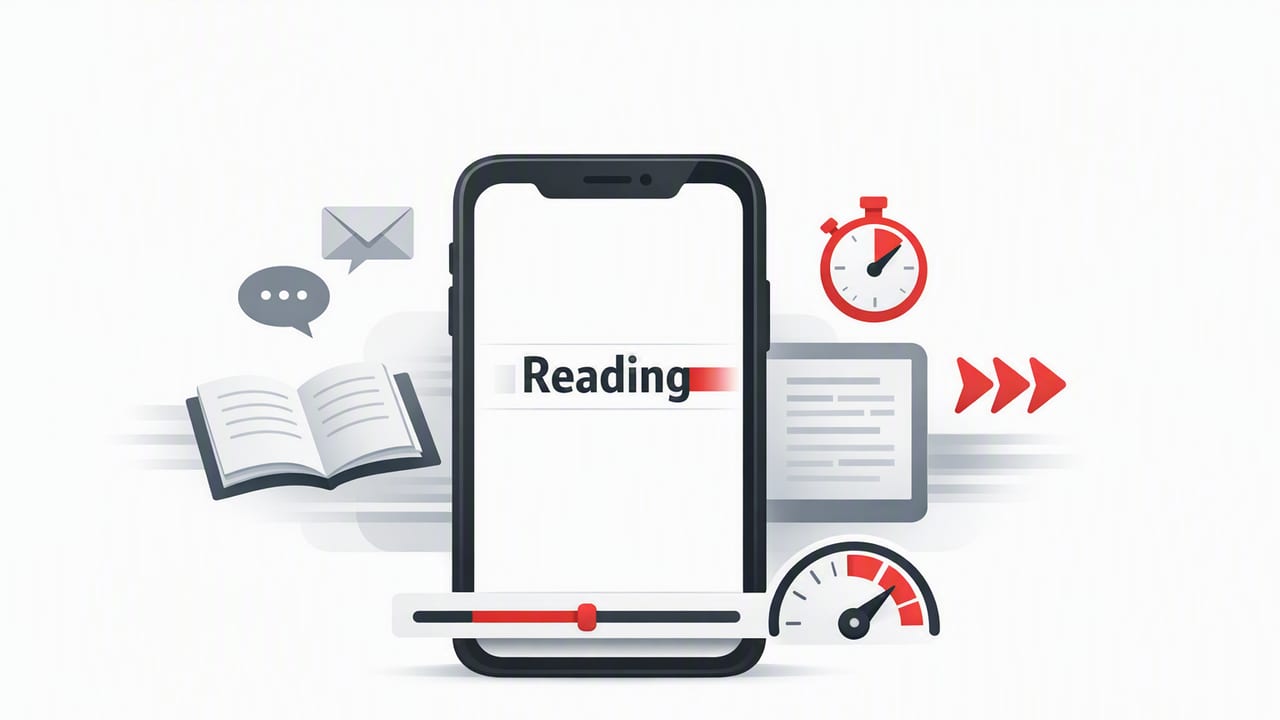
If you’ve ever wished you could get through articles, PDFs, and study notes faster—without your eyes constantly jumping across the page—an RSVP reading app is one of the most practical tools you can add to your iPhone or iPad workflow. RSVP (Rapid Serial Visual Presentation) shows words (or small word groups) one at a time in a fixed spot on the screen, so your eyes don’t need to scan lines. Done well, it can improve speed and focus while still supporting comprehension.
This guide explains how RSVP reading works, which settings matter most, and how to build a routine that actually translates into better reading habits (not just higher WPM numbers).
What is RSVP reading, and why does it feel faster?
RSVP presents text sequentially, typically with a visual alignment point (often called the “pivot”) that keeps your gaze anchored. Traditional reading involves frequent saccades (quick eye movements) plus regressions (jumping back). RSVP reduces both by keeping the text stable and timed.
- Less visual scanning: Your eyes stay in one place.
- Fewer regressions: The app controls pacing, which discourages backtracking.
- More consistent attention: A steady rhythm can reduce mind-wandering.
RSVP doesn’t magically “upload” information faster—it removes friction from the mechanics of reading so your attention can stay on meaning.
When an RSVP reading app works best (and when it doesn’t)
RSVP is excellent for linear text and review passes. It’s less ideal for heavily visual layouts, code-heavy documents, poetry, or anything requiring frequent rereading of a specific phrase.
Great use cases
- News articles, essays, reports
- Text-based study notes and summaries
- Draft documents you already understand (second pass)
- Reading on the go when focus is limited
Trickier use cases
- Dense technical material you’ve never seen before
- Tables/figures you must reference repeatedly
- Legal text where exact wording matters line-by-line
The core settings that determine speed and comprehension
Most RSVP tools look similar on the surface, but performance comes from how you configure pacing, chunking, and pauses. If you want an RSVP reading app to feel comfortable for real work, start here.
1) Words per minute (WPM): choose a “training pace,” not your ego pace
A common mistake is setting WPM too high too soon, then blaming RSVP for lower comprehension. Instead, pick a pace you can sustain with low stress and gradually increase.
- Find your comfortable baseline: Start around 250–350 WPM for unfamiliar material.
- Use a step-up approach: Increase by 25–50 WPM after you can finish a full article with good recall.
- Separate “review speed” from “learning speed”: Review can often be 1.3–1.8× faster than first-pass learning.
2) Chunking (one word vs. small phrases)
Some RSVP modes display one word at a time; others show 2–4 words. Chunking can raise speed but may increase cognitive load.
- Single word: Best for precision, new topics, and language learners.
- 2–3 word chunks: Best for familiar prose and review reading.
- 4+ words: Usually only helpful for very easy material—otherwise comprehension can drop.
3) Smart pauses (punctuation and long words)
The most important “hidden” feature in a good RSVP reading app is pause control. Without it, everything moves at the same rate—commas feel too fast, and long words feel too short.
- Punctuation pauses: Add extra time at commas, periods, semicolons, and paragraph breaks.
- Long-word weighting: Give longer words slightly more display time.
- Line/paragraph pause: Helps you reset attention and integrate meaning.
4) Pivot/ORP alignment (the “anchor” point)
Many RSVP readers highlight a character in each word (often near the center). This Optimal Recognition Point reduces the need for micro-movements of your eyes. If the app offers it, keep it enabled—especially on iPhone screens.
5) Font, size, and contrast
RSVP is sensitive to readability. Larger text can reduce strain, even at higher WPM.
- iPhone: Use a slightly larger font size than you think you need.
- iPad: Consider a wider margin or centered display to reduce head/neck movement.
- Dark mode: Useful in low light, but ensure contrast isn’t too harsh.
Recommended starting settings (iPhone vs. iPad)
Use this table as a starting point, then adjust based on comfort and recall.
| Scenario | Device | WPM | Chunking | Pauses |
|---|---|---|---|---|
| First-pass learning (new topic) | iPhone | 250–325 | 1 word | Strong punctuation + long-word weighting |
| First-pass learning (new topic) | iPad | 275–350 | 1–2 words | Strong punctuation + paragraph pause |
| Review pass (you know the context) | iPhone | 350–500 | 2 words | Medium punctuation pauses |
| Light reading (easy prose) | iPad | 450–650 | 2–3 words | Medium punctuation pauses |
A simple 10-minute training routine (that builds real comprehension)
You don’t need hour-long drills. Consistency matters more than intensity. Try this 10-minute structure inside your RSVP reading app:
- 2 minutes: Warm-up at an easy pace (baseline WPM).
- 5 minutes: Main set at +25–50 WPM above baseline.
- 2 minutes: Drop back to baseline and focus on retention (mentally summarize each paragraph).
- 1 minute: Recall check: write 3 bullets of what you read (no peeking).
This routine trains speed while keeping your brain accountable for meaning. If recall is weak, keep WPM steady for a few sessions instead of pushing higher.
How to keep comprehension high at faster speeds
The best RSVP readers don’t just “watch words go by.” They actively create structure.
Use a “preview → RSVP → review” loop
- Preview (30–60 seconds): Read headings, first sentences, and any bold terms.
- RSVP pass: Run the article at your chosen WPM with smart pauses enabled.
- Review (1–2 minutes): Re-read key paragraphs at a slower pace or skim normally to connect ideas.
Insert intentional micro-pauses
Even with punctuation timing, you may need manual pauses at key moments (definitions, arguments, steps). A helpful rule:
- Pause at “this is the point” sentences (thesis statements, conclusions, numbered steps).
- Slow down for new terminology.
- Speed up for examples you already understand.
Ask one question while you read
Pick a single guiding question, such as:
- “What problem is this solving?”
- “What are the 3 main claims?”
- “What would I do differently after reading this?”
This keeps attention anchored—especially useful when you’re using an RSVP reading app during short breaks.
Practical workflow: getting text into RSVP mode on iOS
The biggest adoption barrier is friction: copying text, cleaning it up, then starting a session. You can reduce friction with a simple prep step: remove extra line breaks and hyphenation from copied text so RSVP pacing stays smooth.
Here’s a tiny example of text cleanup logic (language-agnostic) you can adapt in your own scripts or automations:
// Pseudo-code: normalize pasted text for RSVP
text = input
text = text.replace("-\n", "")           // fix hyphenated line breaks
text = text.replace("\n", " ")            // convert newlines to spaces
text = text.replace(/\s+/g, " ")         // collapse repeated whitespace
text = text.trim()
output = text
Even if you don’t code, the concept is useful: clean text reads more naturally in RSVP because punctuation pauses happen where they should, not in the middle of wrapped lines.
Troubleshooting: why RSVP feels uncomfortable (and how to fix it)
Problem: “I feel rushed and tense.”
- Fix: Lower WPM by 50–100 and increase punctuation pauses.
- Fix: Reduce chunking to single-word mode.
Problem: “I’m fast, but I’m not remembering anything.”
- Fix: Add a 60-second preview (headings + first sentences).
- Fix: Do a 1-minute recall note after each session.
- Fix: Slow down for unfamiliar sections and speed up only on examples.
Problem: “My eyes get tired.”
- Fix: Increase font size and raise line/paragraph pause slightly.
- Fix: Use iPad for longer sessions; keep iPhone sessions shorter (5–10 minutes).
- Fix: Avoid extreme contrast (pure white on pure black) if it causes strain.
Problem: “Numbers and abbreviations trip me up.”
- Fix: Enable long-word weighting (often helps with dense tokens).
- Fix: Tap-to-pause when you see data you must retain, then resume.
How to choose a good RSVP reading app
If you’re comparing options on iPhone or iPad, prioritize features that support real-world reading, not just impressive demo speeds.
- Fine WPM control (small increments)
- Punctuation-based pauses and paragraph breaks
- Word/phrase chunking options
- Pivot/ORP highlighting
- Easy import (copy/paste, share sheet, or document support)
- Session stats (useful for habit-building, not obsession)
Putting it all together
The best way to use an RSVP reading app is to treat it like a focus tool: configure it for comfort, build a short daily routine, and measure success by recall and completion—not just WPM. Start with conservative speeds, lean on smart pauses, and gradually expand your range as comprehension stays stable.
If you’re looking for a polished iOS option that supports RSVP-style speed reading on iPhone and iPad, you can explore FocalRead and apply the setup principles above.