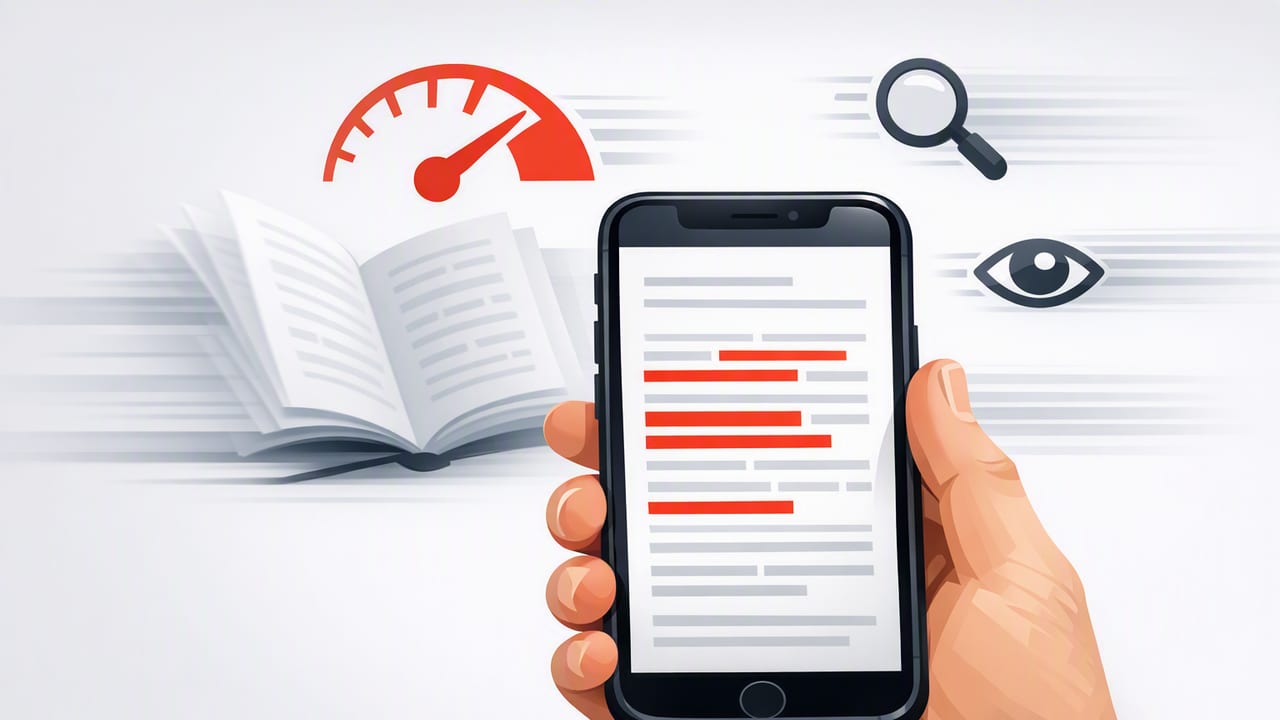
Reading on a phone is convenient, but it can also feel slow: endless scrolling, constant notifications, and a screen that encourages skimming without remembering. The good news is that speed reading on iPhone is absolutely trainable—if you approach it as a skill (not a gimmick) and practice in a way that protects comprehension.
This guide walks you through how speed reading works on a small screen, which reading modes actually help, the best iPhone settings for focus, and a simple daily routine you can repeat to build speed and clarity together.
What “speed reading” really means on a phone
Speed reading isn’t about racing your eyes across text and hoping meaning sticks. It’s about improving efficiency—getting more understanding per minute by reducing wasted effort.
The three bottlenecks that slow mobile reading
- Regressions: your eyes jump backward to re-check words or lines (common on small screens).
- Subvocalization overload: “hearing” every word in your head can cap your speed, especially in long articles.
- Attention switching: notifications, multitasking, and visual clutter break your working memory.
Speed comes less from pushing harder and more from removing friction: fewer backtracks, fewer distractions, and a steadier rhythm.
On iPhone, the goal is to create a controlled reading environment and then train your brain to process text in slightly larger chunks—while checking comprehension frequently.
Pick the right reading mode: scrolling vs. RSVP vs. page view
Different formats encourage different eye behaviors. Some naturally reduce regressions; others support deep comprehension. Use the mode that matches your purpose.
| Mode | Best for | Why it helps | Watch out for |
|---|---|---|---|
| Normal scrolling | Casual reading, short updates | Familiar, flexible pace | Easy to reread lines (regressions) and lose your place |
| Page view | Books, long-form reading | Stable layout reduces “where was I?” moments | Small text can cause eye strain if not adjusted |
| RSVP (one word/phrase at a time) | Training speed, focused bursts | Minimizes eye movement and regressions | Can reduce comprehension if you jump too fast too soon |
| Listen + read (TTS) | Dense material, fatigue days | Dual-channel support can stabilize attention | Speed gains are limited by audio comfort |
If your main objective is speed reading iPhone training, RSVP-style reading is often the most “skill-building,” while page view is excellent for applying that skill to real-world reading.
Optimize iPhone settings for faster reading (without burning out)
Small tweaks can reduce eye strain and keep attention steady—both prerequisites for sustainable speed.
1) Make the text easier to process
- Increase text size slightly until you can read without squinting. Bigger isn’t always better—aim for comfort, not maximum size.
- Use Reader mode in Safari when possible to remove clutter (ads, sidebars, popups).
- Prefer left-aligned text (not justified) to avoid uneven spacing that slows scanning.
2) Reduce visual fatigue
- Lower brightness to a comfortable level, especially at night.
- Try Reduce White Point (Settings → Accessibility → Display & Text Size) if white backgrounds feel harsh.
- Use Dark Mode if it helps your eyes—test both; some readers are faster on light backgrounds.
3) Protect your attention
- Turn on Focus mode (e.g., “Reading”) to silence notifications for 10–20 minutes.
- Use Airplane Mode for short training sprints if you can.
- Full-screen the text to reduce the temptation to multitask.
A 10-minute daily routine to build speed and comprehension
The fastest improvements come from short, consistent practice. Here’s a repeatable session you can do every day.
- 1 minute: Warm-up (easy text)
Read something light at a relaxed pace to “wake up” attention. - 2 minutes: Baseline read
Read a short passage normally. Note your approximate WPM and a quick comprehension score (details below). - 4 minutes: Speed drill
Use RSVP or a paced reading method to push speed in a controlled way. - 2 minutes: Comprehension check
Answer a few questions about what you just read (no peeking). - 1 minute: Cool-down (apply to real reading)
Read a paragraph of something you actually need to understand (work/study), slightly faster than usual.
How to do the speed drill (simple, effective options)
- RSVP ramping: Start at a comfortable speed (e.g., 250–300 WPM). Increase by 25–50 WPM each minute. If comprehension collapses, step back.
- Chunking practice: Instead of reading word-by-word, intentionally group 2–4 words at a time. This works best on familiar topics.
- Anti-regression rule: For the drill only, do not go back. Mark confusing spots mentally and keep moving—then review after.
Quick comprehension scoring (30 seconds)
After each session, rate comprehension using three prompts:
- Main idea: Can you summarize the passage in one sentence?
- Key details: Can you recall 3 specific points?
- Purpose: Can you explain why the author wrote it?
Score each 0–2 (0 = no, 1 = partly, 2 = yes). Total out of 6. If you’re consistently below 4/6, slow down and rebuild accuracy.
How to increase WPM without losing meaning
The common trap is chasing a number (WPM) while sacrificing understanding. Instead, use a tiered approach—different speeds for different goals.
The 3-speed system (use it on iPhone daily)
- Survey speed: Fast scan to understand structure (headings, first sentences, bold terms).
- Learning speed: Moderate pace for comprehension; pause to connect ideas.
- Reference speed: Very fast “find what I need” reading using search, keywords, and skimming.
Most people try to read everything at “learning speed,” which is exhausting. On a phone, switching speeds intentionally is a major productivity boost.
Use the 70/30 rule for difficult material
Spend 70% of your time reading at a pace where comprehension is high, and 30% pushing speed during drills. This keeps progress steady while protecting real-world outcomes (grades, decisions, work quality).
Common mistakes that stall progress
- Jumping speeds too quickly: If you double your WPM overnight, comprehension usually drops. Increase gradually.
- Training only on easy text: You need some challenge to adapt. Mix in medium difficulty passages.
- Never measuring comprehension: WPM alone is not the goal. Track understanding explicitly.
- Reading while multitasking: Speed reading requires stable attention. Split attention destroys retention.
- Ignoring fatigue: If your eyes are dry or your focus is gone, stop. Short breaks prevent “junk practice.”
A practical iOS workflow for reading articles and PDFs faster
Faster reading often starts before you read. The best workflow removes friction so your brain can stay in the text.
For web articles (Safari)
- Open the article in Safari.
- Tap Reader (if available) to simplify layout.
- Set a timer for 10 minutes (Focus session).
- Read headings first, then the first sentence of each paragraph (survey speed).
- Return to sections that matter and read them at learning speed.
For PDFs (Files app or a PDF reader)
- Start with the outline (table of contents) if available.
- Search keywords (e.g., definitions, formulas, project requirements).
- Use highlights sparingly: highlight only sentences you’d want to revisit later.
Optional: a simple Shortcut-style “Read Later” capture
If you use iOS Shortcuts, you can create a quick action that saves links to a notes file so you read in batches (instead of scattering attention all day). Conceptually, the steps look like this:
Shortcut: Save to Reading Queue
1) Accept input: URL from Share Sheet
2) Get current date
3) Append to Note:
   "- [Title](URL) — Date"
4) Show notification: "Saved to Reading Queue"
This supports speed reading because you’re practicing in focused blocks, not between interruptions.
Track progress with the metrics that matter
Progress feels motivating when it’s visible. Track two numbers: speed and comprehension. Here’s a simple weekly log template:
| Metric | What to record | Target trend |
|---|---|---|
| WPM (training) | Average WPM during drills | Gradual increase |
| Comprehension (0–6) | Score from the 3 prompts | Stay ≥ 4 most days |
| Consistency | Sessions per week | 4–6 sessions |
| Real-world payoff | Tasks finished (chapters, reports, articles) | More completed with less fatigue |
Putting it all together
The most reliable path to speed reading iPhone improvement is simple: optimize your reading environment, practice in short daily bursts, and treat comprehension as non-negotiable. Within a few weeks, most readers can meaningfully increase pace—especially on familiar topics—while staying clear and confident about what they read.
If you prefer practicing with dedicated RSVP modes and built-in pacing tools, a speed reading app for iPhone and iPad such as FocalRead can make the daily routine easier to stick with.