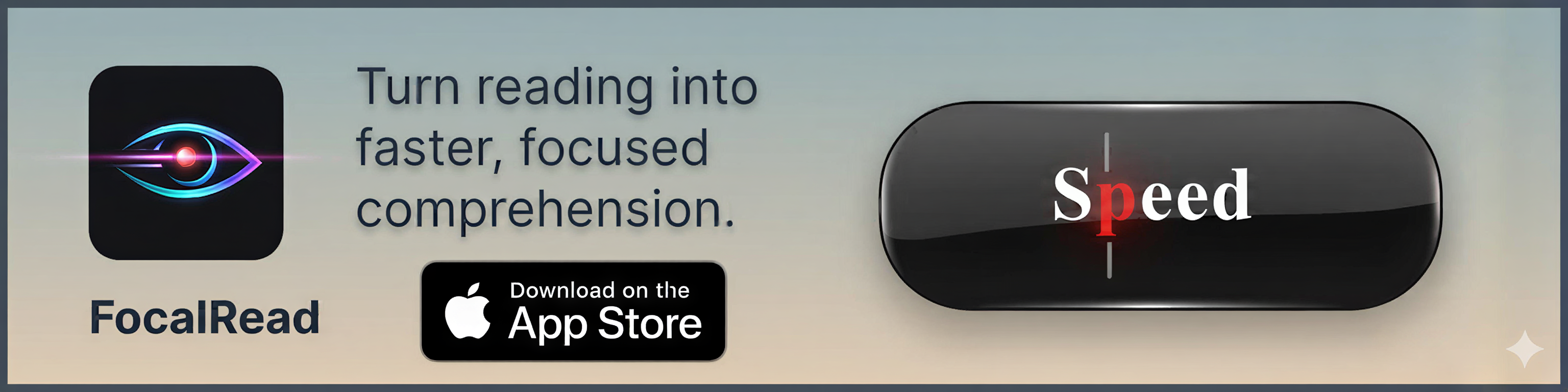
If you’ve ever watched words flash one at a time in the same spot on your screen and thought, “I could read so much faster like this,” you’ve already seen the core idea behind spritz-style reading. This approach is commonly known as RSVP (Rapid Serial Visual Presentation): instead of your eyes moving across lines of text, the text moves to you—one word at a time, anchored in a fixed position.
Spritz became a popular label for this technique, but the concept is broader than any single brand: RSVP is a reading mode that aims to reduce time lost to eye movement and improve focus by limiting visual distractions. Used well, it can be a practical tool for students, professionals, and avid readers who do a lot of digital reading on iPhone and iPad—especially for articles, briefs, emails, and notes.
This guide breaks down how spritz/RSVP works, what it’s good for (and what it’s not), and a realistic practice plan to get faster without sacrificing comprehension.
What “Spritz” (RSVP) Actually Does
Traditional reading requires constant saccades (quick eye jumps) and fixations (brief stops). Even skilled readers lose time re-finding their place, scanning back, and dealing with line breaks and clutter.
Spritz-style RSVP changes the mechanics:
- One word at a time appears in a fixed location.
- The display often uses an Optimal Recognition Point (ORP)—a highlighted letter near the center of each word—so your eyes can “lock on” faster.
- Pacing is controlled in words per minute (WPM), so you can steadily increase speed.
In other words, RSVP attempts to remove the biggest bottlenecks in on-screen reading: eye travel and visual scanning.
Key idea: RSVP doesn’t magically “make you smarter.” It changes the presentation to reduce friction, which can help you sustain speed and focus—when the material is a good fit.
When Spritz Reading Works Best (And When It Doesn’t)
RSVP can feel incredible for certain types of content, and frustrating for others. Knowing the difference is the fastest path to getting real value out of it.
Great use cases
- Articles and blog posts with straightforward narrative flow
- Emails and memos you need to process quickly
- Meeting notes and summaries
- Familiar topics where you already have context
- Language practice for fluency drills (at moderate speeds)
Harder use cases
- Dense textbooks with heavy concept stacking
- Math, code, or formulas where layout matters
- Poetry and style-driven writing
- Reference reading that needs scanning, jumping, and comparing sections
Why the mismatch? RSVP is linear: it prioritizes forward motion. Some material requires non-linear behaviors—skipping, re-reading, comparing diagrams, or pausing to reason through steps.
Spritz vs. Traditional Speed Reading: What’s Different?
Speed reading advice often centers on widening your visual span, reducing subvocalization, and using a pointer. RSVP takes a different route: it controls the stream so your eyes don’t wander.
| Method | What it optimizes | Best for | Main limitation |
|---|---|---|---|
| Spritz / RSVP | Minimizes eye movement; steady pacing | Linear content, focused reading sessions | Harder to skim/scan; re-reading can feel clunky |
| Skimming | Finding key ideas fast | Previews, research, deciding what to read | Misses nuance; weaker retention |
| Pointer/guide reading | Reduces regressions and distractions | Print or long-form text | Still requires eye travel across lines |
| Deep reading | Comprehension and insight | Complex topics, literature, learning | Slower by design |
The most productive readers don’t pick one method forever—they switch modes based on goal and text complexity.
How to Set Your WPM Without Crashing Comprehension
A common mistake is jumping to a high WPM because RSVP makes it feel doable—until you realize you can’t summarize what you read. A better approach is to treat speed as a dial you adjust by content type.
Practical WPM ranges (starting points)
- 250–350 WPM: careful comprehension (good for new topics)
- 350–500 WPM: everyday productivity reading (articles, memos)
- 500–650 WPM: fluent topics and lighter content
- 650+ WPM: advanced drills, usually lower retention unless material is very familiar
Don’t chase a number. Instead, test your understanding with a simple rule: if you can’t write a 2–3 sentence summary immediately after a section, slow down 10–15% and try again.
A Simple Spritz Practice Plan (10 Minutes a Day)
Consistency matters more than intensity. Here’s a short plan that fits into a commute, a study break, or a morning routine.
- Warm up (2 minutes): start at a comfortable speed where comprehension feels easy.
- Build phase (5 minutes): increase WPM gradually (for example, +25 WPM per minute) until you notice strain.
- Settle phase (2 minutes): drop back 10–15% and maintain smooth comprehension.
- Recall test (1 minute): write or speak the main point and 3 details.
This trains both speed and understanding. The recall test is essential: it stops you from confusing “fast scrolling” with “reading.”
Comprehension Tricks That Make RSVP More Effective
Spritz-style reading is powerful, but it needs supporting habits—especially if you’re reading to learn.
1) Pre-read the structure
Before starting RSVP mode, spend 20–30 seconds scanning:
- Headings and subheadings
- Bolded terms
- Any summary or conclusion
This creates a mental outline so incoming words have “hooks” to attach to.
2) Use deliberate pauses
RSVP should not be a nonstop treadmill. Pause intentionally:
- After each paragraph
- After any definition or key claim
- When you detect confusion (don’t push through)
Those pauses are where comprehension consolidates.
3) Chunk by meaning, not by time
If the tool allows it, break reading into sections (e.g., 150–300 words) and do a quick “what did I just read?” check before continuing.
4) Decide your goal upfront
Ask one question first:
- Outcome reading: “What decision do I need to make after this?”
- Learning reading: “What concepts must I be able to explain?”
- Exploratory reading: “Is this worth deeper time?”
RSVP shines most in outcome and exploratory reading, and can support learning when combined with note-taking and review.
iPhone & iPad Setup Tips for Spritz-Style Reading
Because RSVP is visually demanding in its own way, your device setup can make or break the experience.
- Use a comfortable font size: if words feel cramped, you’ll fatigue faster.
- Prefer high contrast: dark text on light background (or vice versa) with crisp edges.
- Reduce distractions: enable Focus mode/Do Not Disturb during short sessions.
- Stabilize your posture: prop the iPad or rest elbows; RSVP is easier when your screen doesn’t move.
- Adjust for long words: if the tool supports it, slow slightly on longer words or add automatic micro-pauses.
A Quick Self-Test: Are You Actually Understanding?
Use this 60-second test after any RSVP session:
- Write one sentence that captures the main point.
- List three supporting details.
- Write one question you still have.
If you can’t do #1, you were probably going too fast. If you can do #1 but not #2, slow down slightly or add pauses at paragraph boundaries. If you can do all three, you’ve found a workable speed.
Optional: A Tiny RSVP Timer Concept (For the Curious)
If you like to understand the mechanics, RSVP is basically a timed loop that advances through words at a given interval. Conceptually:
// Pseudocode: RSVP pacing
words = split(text)
intervalMs = 60000 / wpm
for word in words:
  display(word)
  wait(intervalMs)
Many RSVP readers add smarter behavior (pauses for punctuation, longer delay for long words, and quick rewind). Those small details often make the difference between “novelty” and “usable tool.”
Common Mistakes to Avoid with Spritz Reading
- Starting too fast: comfort first, speed second.
- Never pausing: comprehension needs breathing room.
- Using RSVP for everything: some content needs scanning and re-reading.
- Ignoring fatigue: RSVP can strain attention; do shorter sessions.
- Measuring success only by WPM: measure by recall and usefulness.
Putting It All Together: A Balanced Reading Workflow
A practical way to use spritz/RSVP on iOS is as one mode within a larger workflow:
- Scan first (headings, key terms, conclusion).
- RSVP the main body at a sustainable WPM with paragraph pauses.
- Switch to normal scroll for any section that’s confusing, technical, or critical.
- Do a 60-second summary to lock in comprehension.
This hybrid approach preserves the speed advantage of RSVP while respecting how learning and analysis actually work.
Conclusion
Spritz-style RSVP reading is best understood as a focus tool that can also increase speed—especially for linear, digital text. It reduces eye movement, keeps your attention anchored, and makes it easier to maintain a steady pace. But it isn’t a universal replacement for deep reading, scanning, or careful study.
If you want to experiment with RSVP on iPhone or iPad, choose a reader that lets you control WPM, pause easily, and handle punctuation smoothly—then build the habit with short daily sessions and consistent recall checks. (For example, apps like FocalRead include speed-reading modes designed for iOS workflows.)