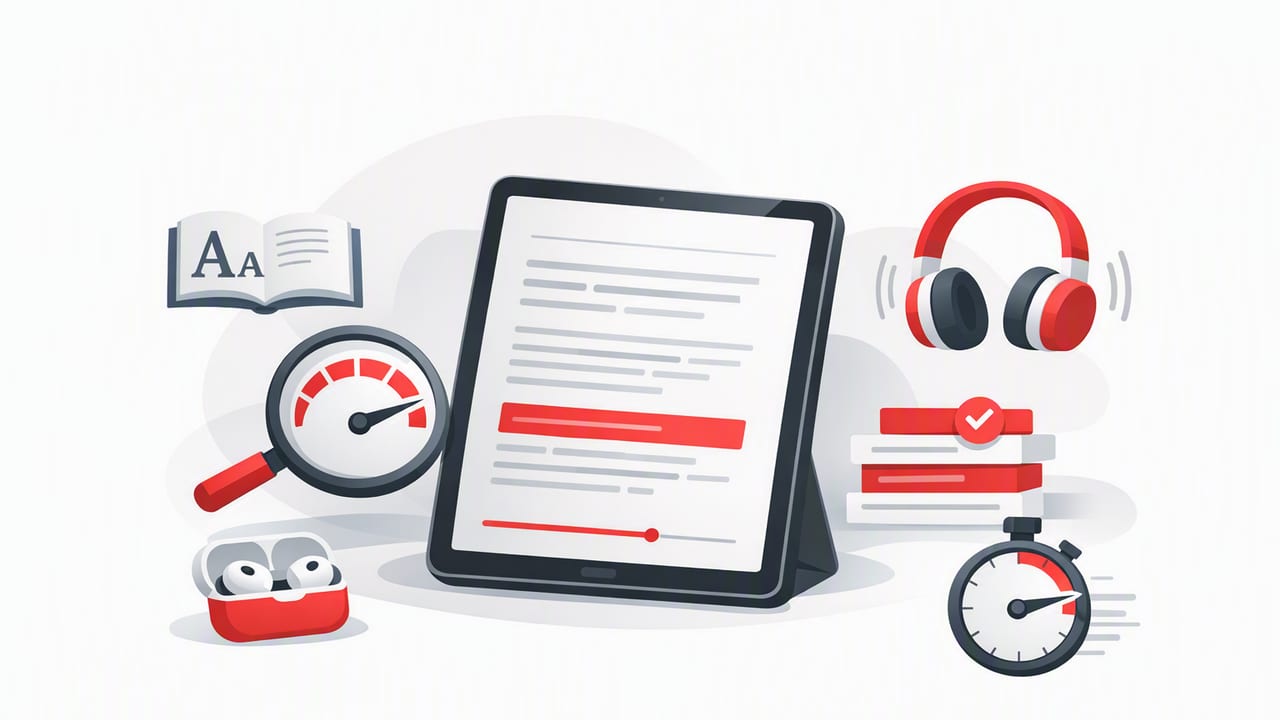
Reading on an iPad can be dramatically faster than reading on paper—if you set it up for speed and focus. The challenge is that iPad reading often happens inside noisy environments: notifications, multitasking, endless tabs, and poorly formatted PDFs. The solution is not a single “speed reading trick,” but a small set of tools to read faster on iPad that work together: device settings, smart reading modes, frictionless capture, and quick comprehension checks.
This guide walks through a practical system you can use for articles, textbooks, reports, and PDFs. You’ll learn what to turn on in iPadOS, which reading views reduce eye strain and regressions, and how to build a repeatable workflow that increases reading speed without losing the point.
What “reading faster” actually means (and what to measure)
Reading speed is often treated like a single number (words per minute), but real-world reading has three goals:
- Speed: moving through text efficiently without constant backtracking.
- Comprehension: extracting the author’s key claims, structure, and evidence.
- Retention: remembering enough to use what you read later.
On iPad, the biggest speed killers are:
- Regressions: frequent re-reading of lines because your eyes lose place.
- Low focus time: interruptions break your context and add re-orientation time.
- Bad formatting: tiny fonts, dense columns, and poor PDF layouts.
To improve, track two simple metrics for one week:
- Time-to-finish an article or section (minutes).
- One-sentence summary quality (can you explain it clearly without looking?).
iPad settings that make reading faster (and less tiring)
Start with device-level changes. They reduce distractions and eye fatigue, making speed gains easier to sustain.
1) Use Focus modes to remove “attention tax”
Even if you don’t open notifications, seeing them costs attention. Configure a reading-only Focus:
- Allow notifications only from truly urgent contacts/apps.
- Hide badge counts for social and messaging apps during reading sessions.
- Use a dedicated Home Screen page that contains only reading tools.
2) Tune text size and contrast for fewer regressions
If your eyes strain, your brain pays with comprehension and you re-read more. Try:
- Larger text than you think you need for long sessions (especially in PDFs).
- Reduce transparency and increase contrast if you read in variable lighting.
- Night Shift or warmer display in the evening to reduce fatigue.
3) Prefer landscape for dense material
For PDFs and textbooks, landscape can shorten line length (fewer horizontal eye jumps), which often improves speed and reduces losing your place.
4) Use Split View intentionally (not by habit)
Multitasking can help if it reduces switching. Good uses:
- Text on one side, notes on the other.
- Article on one side, glossary/definitions on the other.
Bad use: reading plus chat/social apps. That increases context switching and slows reading more than you think.
Reading modes and tools: what to use for each type of text
Different content needs different “views.” Here’s a practical breakdown of common reading tools on iPad and what they’re best at.
| Tool / Mode | Best for | Why it helps you read faster | Watch out for |
|---|---|---|---|
| Reader view (simplified article view) | Web articles | Removes ads/sidebars, improves line length and spacing | Charts/interactive elements may disappear |
| PDF reflow / text view (when available) | PDFs with selectable text | Converts dense layouts into easier-to-scan text | Complex formatting can break |
| Highlight + quick notes | Study and work documents | Prevents re-reading by capturing key points on first pass | Over-highlighting becomes noise |
| Speed reading / RSVP modes | Linear prose, drafts, long emails | Reduces regressions; enforces steady pace | Not ideal for tables, equations, or code |
| Text-to-speech | Proofreading, tired eyes, commuting | Adds an audio channel; can increase throughput | Harder to scan; comprehension varies by voice speed |
A fast iPad reading workflow (15–25 minutes per session)
This workflow is designed for consistency. It prevents the two biggest time sinks: starting without a plan and re-reading without a purpose.
Step 1: Preview for structure (2 minutes)
Before you read line-by-line, do a quick “map” pass:
- Scan headings and subheadings.
- Look at bolded terms, charts, and summaries.
- Ask: What problem is this trying to solve? and What would I do with this info?
Step 2: Set a target (30 seconds)
Pick one of these targets:
- Inform: “I just need the key idea and 3 supporting points.”
- Apply: “I need steps I can follow later.”
- Evaluate: “I’m judging whether the argument is credible.”
Step 3: Choose the right reading mode (10–18 minutes)
Use the tool that matches your target:
- Inform: Reader view + faster scrolling pace, minimal highlighting.
- Apply: Normal view + capture actionable steps as a checklist.
- Evaluate: Slower pace + note assumptions, evidence, and counterpoints.
Speed tip: if you catch yourself re-reading the same paragraph twice, stop and write a one-line paraphrase in your own words. This is usually faster than a third re-read.
Step 4: Do a 60-second comprehension check
Close the document (or look away) and answer:
- What’s the main claim?
- What are the top 3 supporting points?
- What would I do differently because of this?
Rule of thumb: If you can’t summarize it simply, don’t increase speed yet—fix clarity first. Speed builds on understanding.
Three practical techniques that boost speed without “skipping meaning”
1) Use a visual pacer (without obsessing over WPM)
A visual pacer is anything that guides your eyes forward: your finger on the screen, Apple Pencil, or a steady scroll. The goal is to reduce wandering eye movements and regressions.
Try this for articles:
- Scroll smoothly at a comfortable pace for 3 minutes.
- If you miss something, pause instead of snapping backward immediately.
- Only regress after the paragraph, not mid-sentence.
2) Highlight only “spines,” not “skin”
Over-highlighting slows you down and makes review useless. Highlight:
- Definitions that unlock the rest of the text
- Main claims and conclusions
- Numbered steps, criteria, or frameworks
Skip highlighting: examples, anecdotes, and repeated explanations (unless you need them for your purpose).
3) Convert reading into a short output
Your brain reads faster when it knows what it’s producing. Pick one output format:
- 1-sentence takeaway (best for news and blog posts)
- 3-bullet summary (best for reports)
- Checklist (best for how-tos)
- Pros/cons table (best for evaluating decisions)
Automation: a simple iPad Shortcut to start a reading session
Automation reduces friction—especially if you read in small pockets of time. If you use the Shortcuts app, you can create a “Reading Sprint” that turns on your reading Focus, starts a timer, and opens your reading list.
Here’s a conceptual example in pseudo-Shortcut steps (not code you run in a terminal, but a helpful blueprint):
Reading Sprint (20 minutes)
1. Set Focus: Reading (On)
2. Set Brightness: 55%
3. Start Timer: 20 minutes
4. Open App: Safari (or your PDF reader)
5. Open URL: your Reading List / saved articles page
6. After timer ends: Show notification "Write 3-bullet summary"
This works because it standardizes your environment: fewer distractions, consistent session length, and a built-in comprehension prompt.
Common iPad reading scenarios (and the fastest tool choice)
Scenario A: You’re reading long web articles
- Use simplified article view (Reader-style view).
- Increase font size slightly and widen line spacing if available.
- Capture one-sentence takeaway at the end.
Scenario B: You’re reading PDFs for school or work
- Try reflow/text view if the PDF allows selectable text.
- Use landscape for dense pages; zoom to avoid tiny text.
- Mark only definitions, claims, and conclusions; avoid highlighting every example.
Scenario C: You’re reading to make a decision (purchase, plan, strategy)
- Skim headings first; pull key criteria into a short list.
- Read only sections that map to your criteria.
- Create a quick pros/cons note so you don’t re-read later.
How to know you’re ready to increase speed
Increase pace when these are true:
- You can summarize each section without looking back.
- You’re making fewer regressions (less “scroll back up”).
- Your notes are shorter but more meaningful.
If comprehension drops, don’t blame speed alone. Often the issue is tool mismatch (e.g., RSVP mode for a table-heavy PDF) or unclear purpose (reading without a target).
Putting it together: your minimal “fast reading kit” on iPad
If you want the simplest stack of tools to read faster on iPad, start here:
- Reading Focus mode (notifications off, dedicated Home Screen)
- Reader-style article view for web content
- PDF tool with reflow/annotation (when your documents support it)
- One output habit: 3 bullets or a checklist per session
- Optional speed-reading mode for linear text when you want a steady pace
Once those are in place, speed improvements tend to compound: your eyes move more consistently, your attention breaks less often, and you spend less time re-reading because your notes and summaries preserve meaning.
Gentle note: if you prefer a dedicated speed-reading experience on iPhone and iPad, an app like FocalRead can provide paced reading modes and focus-friendly tools to support the workflow above.